---
title: AI Data Entry Accuracy & Efficiency
description: AI reduces data entry errors to 99%+ accuracy, cuts processing time by up to 90%, and lowers costs in Fintech and Hospitality.
image: https://optiblack.com/hubfs/Optiblack%20Vishal%20Rewari%20Product%20Analytics%20(8)-4.png
---
OPTIBLACK
- [Services](https://optiblack.com/services)
- [Customers](https://optiblack.com/customers)
[Book a strategy call](https://optiblack.com/book-a-call)
- [Services](https://optiblack.com/services)
- [Customers](https://optiblack.com/customers)
[Book a strategy call](https://optiblack.com/book-a-call)
[Information](https://optiblack.com/insights/tag/information) Jul 9, 2026, 2:06:53 PM · 15 min read
# How AI Improves Data Entry Accuracy

Vishal Rewari
Optiblack
-4.png)
**Manual data entry is costly, error-prone, and time-consuming. AI offers a better solution.** With accuracy rates exceeding 99%, AI-powered tools drastically reduce mistakes, speed up workflows, and lower costs. Industries like Fintech and Hospitality are already seeing the benefits: fewer billing errors, faster reconciliations, and improved data consistency.
Key takeaways:
- **Error reduction**: Manual error rates (5-10%) drop to less than 1% with AI.
- **Cost savings**: Fixing one invoice error manually can cost $53; AI minimizes these corrections.
- **Time efficiency**: AI cuts data entry time by 80-90%, freeing up teams for strategic tasks.
- **Scalability**: AI handles high volumes effortlessly, unlike manual processes.
AI tools process data from diverse formats (PDFs, handwritten notes, etc.), flag anomalies, and learn from corrections to improve over time. By integrating AI into workflows, businesses in Fintech and Hospitality save money, reduce risks, and focus on what matters most: delivering better outcomes.
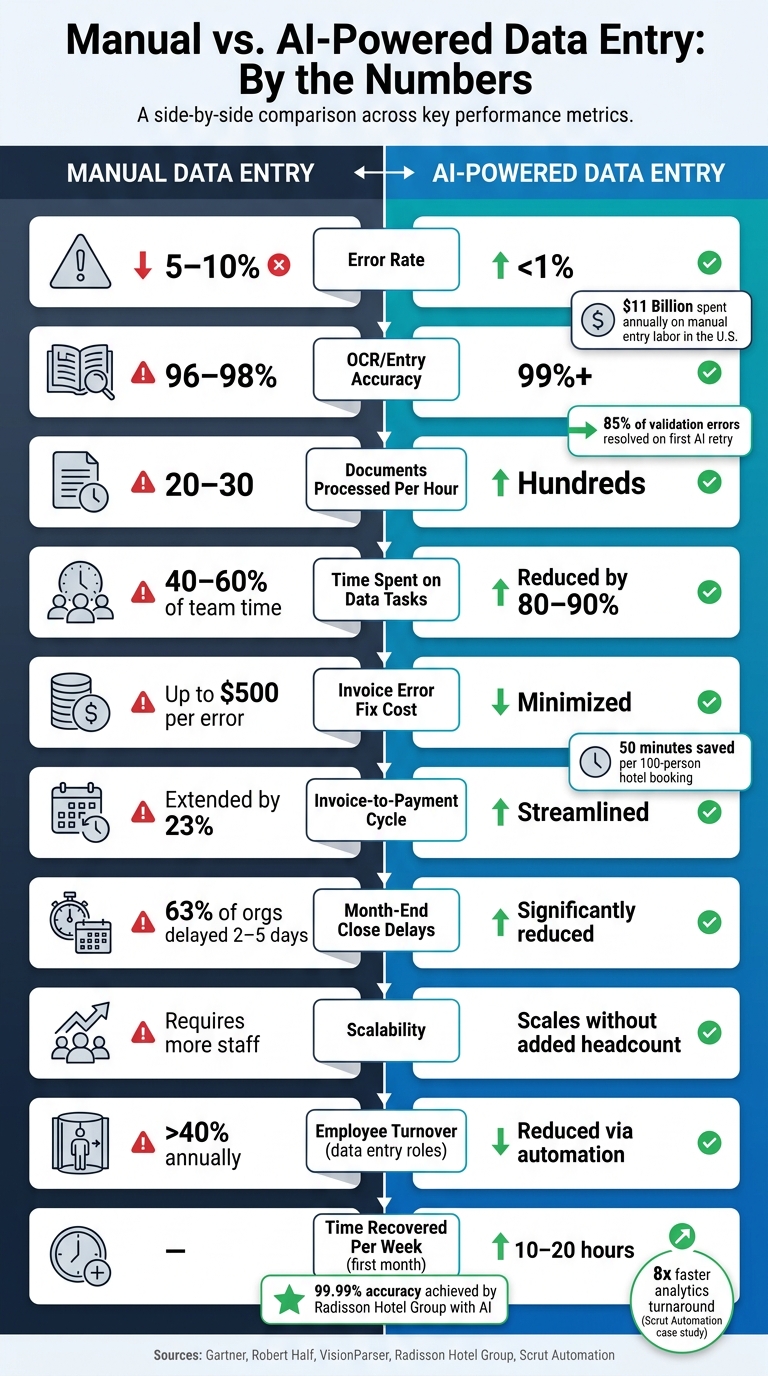
Manual vs. AI Data Entry: Key Stats & Performance Metrics
## How to validate AI data extraction accuracy | [Affinda](https://www.affinda.com/)
VIDEO
## Manual Data Entry Problems in Fintech and Hospitality
Before diving into AI-driven fixes, it's important to see why manual processes can cause so many headaches in Fintech and Hospitality. Manual data entry isn’t just slow - it’s costly. Across both industries, the same types of errors keep popping up, and the ripple effects are often more harmful than many realize.
### Common Errors and Their Business Impact
In Fintech, frequent mistakes include using the wrong GL codes, which misallocate expenses, or entering dates in the wrong format (DD/MM instead of MM/DD). Fixing an error at the entry stage costs around **$1–$5**, but if it slips through to a customer account or a regulatory filing, that cost can skyrocket to **$50–$500**.
In Hospitality, the issues often start with the source documents. Think about faded receipts, damaged delivery forms, or handwritten guest forms - these make accurate transcription tricky. The result? Wrong contact details, incorrect billing addresses, or phone numbers that don’t even follow a valid format. These errors lead to friction during check-in and billing disputes later.
Even a seemingly small error rate, like 1% per field, means that roughly 1 in 10 invoices will require manual corrections. These mistakes not only hurt accuracy but also drive up operational costs and waste time.
### Time and Cost Losses from Manual Processes
The labor demands of manual data entry are staggering. Finance teams in both industries spend **40% to 60% of their time** on tasks like transcription and validation. That’s time that could be better spent on strategic work.
The costs add up quickly. U.S. companies collectively spend about **$11 billion annually** on manual data entry labor. On top of that, manual workflows extend invoice-to-payment cycles by **23%**. During audits or month-end close, the situation gets worse: **25% of organizations** take over 20 days to close their books due to manual reconciliation bottlenecks.
And then there’s the toll on employees. The repetitive nature of data entry leads to burnout and high turnover, with annual turnover rates exceeding **40%** in these roles. Replacing a single worker isn’t cheap either - it can cost **50% to 100%** of their annual salary.
> "Data entry is repetitive, low-autonomy work... the top reason AP clerks leave is 'too much manual, repetitive work.'" - Robert Half (via Lido.app)
Beyond the time and money wasted, inconsistent data formats make things even messier.
### Managing Inconsistent Data Formats
Both industries face a jumble of input types: scanned PDFs, digital forms with different layouts, CSV files with mismatched schemas, and handwritten notes. Each source follows its own rules - varying date formats, inconsistent currency symbols, or phone numbers in multiple styles. Someone has to manually standardize all this data before it’s usable.
This is where **"silent errors"** thrive. A small mistake, like a transposed digit or a field mix-up (e.g., recording an invoice number as a PO number), can create records that *look* correct but are actually wrong. These errors don’t trigger alarms; they quietly disrupt reporting. According to [Gartner](https://www.gartner.com/en), **poor master data quality causes 40% of all finance automation errors**, and reconciliation mistakes delay month-end closes by **2 to 5 days** for 63% of organizations.
## How AI Improves Data Entry Accuracy
Fixing errors manually is a band-aid solution. AI tackles the problem at its root. Here's how [AI-driven tools](https://optiblack.com/ai-accelerator) for capture, validation, and learning eliminate errors in data entry.
### Automated Data Capture and Validation
Traditional OCR systems rely on fixed templates to locate data. If a layout shifts, a field moves, or a vendor changes, the system breaks. **AI-powered OCR, however, works more like a human.** It uses contextual understanding to identify data no matter how the page is arranged.
Adding a layer of **Intelligent Document Processing (IDP)** takes this a step further. IDP applies business rules to the extracted data, performing tasks like calculating due dates, assigning GL codes, or verifying calculations such as `quantity × price = line total`. Meanwhile, Natural Language Processing (NLP) ensures the system understands that terms like "Bill To", "Sold To", and "Client" all refer to the same concept.
While traditional OCR systems typically achieve 85–90% accuracy, AI-based OCR can hit **99% or higher**. Finance teams using these tools report reducing data entry errors by **90% or more**.
### Error Detection and Anomaly Flagging
AI doesn't just extract data - it evaluates it. Each data field is assigned a confidence score that determines its reliability. High-confidence fields are processed automatically, while low-confidence ones are flagged for human review.
This approach is key to catching "silent errors" that might otherwise slip through. For example, an AI system can instantly flag issues like transposed digits, mismatched vendor names, or tax amounts that don't align with the invoice total. AI systems also use a **null-first strategy**, meaning if a field can't be confidently read, it returns a blank instead of guessing. This reduces false positives by **20%** during data extraction.
| Confidence Level | Score Range | Action Taken |
| --- | --- | --- |
| **Very High** | 0.95+ | Automatically approved for processing |
| **High/Medium** | 0.65–0.80 | Flagged for quick human review |
| **Low/Very Low** | Below 0.40 | Routed to a specialist for manual entry |
> "It's better to return null than hallucinate data. Clients prefer honest null over wrong data." - VisionParser Team
This rigorous validation process is especially crucial in industries like Fintech and Hospitality, where even minor errors can have significant consequences.
### Learning from Corrections Over Time
Unlike systems that rely on rigid rules, AI improves as it learns. When a human reviewer corrects an error, that correction becomes part of the system's training data. Over time, the AI applies these lessons to similar documents, refining its accuracy.
This adaptive learning is particularly effective for recurring document types, such as hotel supplier invoices, bank statements, or guest intake forms. With each iteration, the system gets smarter, and **around 85% of validation errors are resolved on the first retry** through self-correction loops. The longer the system operates, the fewer manual corrections it requires, steadily improving data accuracy for workflows in Fintech and Hospitality.
## AI Data Entry in Action: Fintech and Hospitality Use Cases
AI's ability to improve accuracy is no longer just theoretical - its impact is evident in industries like Fintech and Hospitality. These fields showcase how AI-driven data entry transforms daily operations with measurable results.
### Accurate Transaction Records in Fintech
Imagine a mid-sized payment processor managing **50 million transactions every month** - manually reviewing each one for errors would be impossible. AI changes the game by combining tools like OCR (Optical Character Recognition), NLP (Natural Language Processing), and real-time validation. These systems automatically compare transactions against historical data and business rules, sending only flagged items for manual review. This process, known as Straight-Through Processing, ensures that high-confidence records flow directly into ERPs like [NetSuite](https://www.netsuite.com/portal/home.shtml) or [SAP](https://www.sap.com/index.html). Every record is also tied to its source document and metadata, leaving behind a clear audit trail that simplifies year-end reviews.
The time savings here are massive. AI-powered document processing can cut data entry time by **80–90%**, freeing up **60–80% of the hours** previously spent on manual tasks. Instead of fixing errors, teams can focus on strategic activities like cash flow forecasting or margin analysis. This shift not only improves accuracy but also enables smarter, more data-driven financial decisions.
While Fintech leverages AI for precise transaction management, the Hospitality industry tackles entirely different challenges - like managing diverse guest data.
### Better Guest Data Management in Hospitality
Hospitality operations generate a staggering amount of data. A luxury resort, for instance, might run **40+ systems** - PMS, POS, CRM, accounting - each producing guest data in different formats. Keeping all that data consistent is where manual processes often fail.
In May 2026, [Radisson Hotel Group](https://www.radissonhotels.com/en-us/corporate) partnered with [Hivr](https://amadeus.com/en/newsroom/press-releases/amadeus-commitment-to-ai-innovation-in-hospitality-with-hivr) to create an AI tool designed to simplify rooming list management for group bookings. This tool can handle guest data in virtually any format - Excel files, PDFs, emails, even photos of handwritten notes - and automatically reconcile changes across multiple document versions. The result? A **50-minute time savings per 100-person booking**, with the system delivering **99.99% accuracy** across Radisson's European properties. This efficiency allows staff to focus more on guest experiences and operational planning.
> "It's the most hated job in hotels, dealing with meetings and events. No one wants to do it." - Mandy Stam, Senior Director of Business Solutions, Radisson Hotel Group
AI also makes a difference in hotel finance. For example, The Francis Marion Hotel adopted "DP Invoice", an AI-powered accounts payable solution from Data Plus. According to Mike Abrams, the hotel’s Director of Finance, the tool eliminated hours of manual data entry and approval tasks. It achieved **99.5% USALI coding accuracy** while uncovering real-time spending insights that helped identify cost-saving opportunities.
### Cleaner Data for Reporting and Analytics
AI's impact doesn’t stop at transactions or guest management. It also ensures that data entering your systems is clean and ready for reporting and analytics. Errors like mismatched dates, inconsistent merchant names, or minor currency discrepancies can ripple through dashboards and reports, distorting key insights.
AI tackles this issue by normalizing data at the entry point. For Hospitality teams, this often means reclaiming **10 to 20 hours per week** within the first month of using AI tools. The result? Data that’s standardized, validated, and traceable - providing a reliable foundation for decision-making.
> "The AI is not making pricing decisions. It's removing the time cost of getting to the information that the decision requires." - Studio Oriente
## How to Add AI Data Entry to Your Workflows
### Finding Error-Prone Areas in Your Current Process
AI has shown it can significantly reduce errors, but the first step is identifying where your current data entry processes fall short. Start by observing manual tasks like form submissions, invoice processing, email data extraction, and transferring information between systems. Spend a day shadowing your team to uncover these repetitive tasks. Often, these are performed on autopilot, making them ideal candidates for automation.
> "Shadow your team for a day to catch data entry tasks they do unconsciously - these are often the easiest to automate." - Arahi AI
Once you’ve mapped out your workflows, measure the frequency and impact of errors. Even small mistakes can take 15 to 30 minutes to fix. In high-volume tasks like processing invoices, managing guest records, or logging transactions, these errors quickly add up - making automation a clear opportunity to save time and resources.
### Connecting AI to Your Data Infrastructure
For AI data entry to work seamlessly, it needs to integrate with your existing systems. A typical AI workflow follows five stages: **Ingestion** (input from emails, uploads, or APIs), **Extraction** (converting data into structured formats), **Validation** (applying rules and checks), **Routing** (sending data to tools like CRMs or ERPs), and **Exception Handling** (flagging uncertain entries for human review).
Start small by automating a single high-impact process, such as invoice processing or onboarding new customers. Test the results before expanding. Using your current tech stack - such as [AWS](https://aws.amazon.com/), [Metabase](https://www.metabase.com/), or SAP - can help reduce costs and speed up the implementation. Here’s a quick comparison of manual versus AI-powered data entry:
| Factor | Manual Data Entry | AI-Powered Data Entry |
| --- | --- | --- |
| **Speed** | 20–30 documents per hour | Hundreds of documents per hour |
| **Accuracy** | 96–98% | 99%+ with AI-powered OCR |
| **Scalability** | More staff needed for volume | Scales without additional staff |
| **Cost** | Increases with volume | Cost per document decreases at scale |
With your systems ready for integration, consider working with partners like Optiblack to simplify deployment.
### How [Optiblack](https://optiblack.com/) Supports AI-Powered Data Accuracy
For industries like Fintech and Hospitality, where speed and efficiency are critical, [Optiblack](https://optiblack.com) offers a clear roadmap to adopting AI for data accuracy. They use a **C² (Criticality–Complexity) framework** to identify automation opportunities. This method evaluates workflows across departments to find "winner" use cases - those with high impact but low complexity. For example, in April 2026, Optiblack helped ESME Consumer identify **460+ AI use cases** across seven departments, prioritizing **180+ high-impact opportunities** for a one-year AI plan.
Optiblack also simplifies infrastructure challenges. Their **Data Accelerator** service automates data pipelines from over 200 sources, integrating them with your current tools. Meanwhile, their **Optira Core** solution replaces manual data entry from PDFs, scans, and forms, delivering clean, structured outputs in formats like CSV, Excel, or JSON.
For teams needing additional support, Optiblack uses a **Build-Operate-Transfer (BOT) model**. They handle the initial setup and management of the AI infrastructure, then transition it to your team once it’s fully operational. This approach proved effective in October 2025 when [Scrut Automation](https://www.scrut.io/) achieved an **8x faster analytics turnaround** and saved **80 engineering days** by leveraging their existing AWS and Metabase stack.
> "Optiblack got it done in weeks instead of taking a quarter or two. It was higher quality and more efficient, delivered at a fraction of the cost." - Head of Product, Scrut Automation
Optiblack’s streamlined solutions highlight how AI can transform data entry workflows, especially in fast-paced industries like Fintech and Hospitality.
## Conclusion: What AI Means for the Future of Data Entry
Relying on manual data entry is no longer practical for industries like Fintech or Hospitality. AI systems have reshaped the game, offering unmatched accuracy, reducing operational costs, and saving countless hours of work. This transformation doesn’t just streamline processes - it allows teams to concentrate on more impactful, strategic tasks.
When repetitive tasks are automated, your team shifts from being bogged down by data processing to focusing on analysis, customer relationships, and making smarter decisions. As Lido aptly puts it: *"The team stops being a transaction processing center and starts being a finance team."*
Delaying the adoption of AI only increases costs and risks. Slower payment cycles, compliance issues from manual errors, and employee burnout become expensive problems over time. Losing a single employee to "entry fatigue" can cost a company 50% to 100% of that role’s annual salary just to recruit and onboard a replacement. With today’s AI capable of handling intricate data tasks, postponing adoption is a risk businesses can’t afford.
By 2026, advanced AI systems will manage unstructured data like PDFs, scans, emails, and forms - tasks that previously required human intervention. Starting with one high-volume process, validating outcomes, and scaling up from there offers a low-risk, high-reward approach. In fact, most companies recover 10 to 20 hours per week within the first month of using AI. With proven benefits and mature technology, integrating AI isn’t just an option - it’s a necessity.
> "AI data entry is one of those use cases that sounds boring and turns out to be among the highest-ROI agent deployments in any business." - Arahi AI
For Fintech and Hospitality teams, the real question isn’t whether to adopt AI, but how soon they can get started.
## FAQs
### What data entry tasks should we automate first with AI?
To improve efficiency, prioritize tasks that involve high volumes, follow clear rules, and demand little decision-making. Examples include **processing invoices**, **extracting leads from forms or emails**, and **reconciling expense reports**. Look for workflows handling more than 100 documents monthly or those where mistakes can lead to major operational challenges. Optiblack specializes in simplifying these processes with AI and data infrastructure services, specifically designed for Fintech and Hospitality industries.
### How does AI handle messy inputs like PDFs and handwritten forms?
AI leverages **computer vision** and **multimodal language models** to handle complex inputs such as scanned PDFs and handwritten documents. Through Intelligent Character Recognition (ICR), it transforms images into machine-readable text - even when dealing with low-quality or misaligned files. Multimodal models go a step further by analyzing layouts, interpreting handwriting, and extracting structured data. To maintain accuracy, a validation layer catches errors or low-confidence entries, flagging them for human review to ensure reliable automated data entry.
### How do we keep humans in the loop without slowing everything down?
To keep workflows efficient while involving human oversight, implement **risk-based automation**. Assign AI to handle tasks that are low-risk and have high-confidence outcomes, reserving uncertain cases for human review. Equip reviewers with an interface that displays source documents alongside AI-extracted data, enabling quick and accurate validation. Any corrections made by humans should feed back into the AI system, helping it learn and improve over time. This approach ensures that experts can concentrate on critical tasks while maintaining both speed and precision at scale.

Vishal Rewari
[#Information](https://optiblack.com/insights/tag/information)
/ Keep reading
## More from Optiblack
[-3.png) Case Studies From Zero to a Multi-Region Analytics Backbone: How OptiBlack Built Scrut's Entire Data Platform](https://optiblack.com/insights/from-zero-to-a-multi-region-analytics-backbone-how-optiblack-built-scruts-entire-data-platform) [-4.png) Information AI in Geographic Segmentation: Key Use Cases](https://optiblack.com/insights/ai-geographic-segmentation-key-use-cases) [-3.png) News RealBooks Selects Optiblack as Strategic Analytics Partner to Build Modern Data Stack for Real Estate Investors](https://optiblack.com/insights/realbooks-selects-optiblack-as-strategic-analytics-partner-to-build-modern-data-stack-for-real-estate-investors)
/ 15-minute exploration call
## Turn these insights into revenue.
We'll go through your CRM, product, and analytics data together and show you exactly where growth is leaking. No setup. No dashboards. Just signal.
[Book a strategy call →](https://optiblack.com/book-a-call)
[OPTIBLACK](https://optiblack.com/)
US: 1309 Coffeen Ave, Suite 1200, Sheridan, WY 82801 · +1 682 297 2970 — India: 297 Designs, 74 SBK Society, Paldi, Ahmedabad 380007 · +91 9819394297
Services
[Data services](https://optiblack.com/services) [CRM services](https://optiblack.com/services) [AI services](https://optiblack.com/services) [Book a call](https://optiblack.com/services)
Company
[Customers](https://optiblack.com/customers) [About Us](https://optiblack.com/about-us) [Insights](https://optiblack.com/insights)
© 2026 Optiblack · 2× Mixpanel Partner of the Year · vishal@optiblack.com
```json
{
"@context" : "https://schema.org",
"@type" : "BlogPosting",
"author" : {
"@type" : "Person",
"name" : "Vishal Rewari",
"url" : "https://optiblack.com/insights/author/vishal-rewari"
},
"dateModified" : "2026-07-09T08:36:53.532Z",
"datePublished" : "2026-07-09T08:36:53.000Z",
"headline" : "AI Data Entry Accuracy & Efficiency",
"image" : [ "https://optiblack.com/hubfs/Optiblack%20Vishal%20Rewari%20Product%20Analytics%20(8)-4.png" ],
"mainEntityOfPage" : {
"@id" : "https://optiblack.com/insights/how-ai-improves-data-entry-accuracy",
"@type" : "WebPage"
},
"publisher" : {
"@type" : "Organization",
"logo" : {
"@type" : "ImageObject",
"url" : "https://optiblack.com/hubfs/Group%201234.png"
},
"name" : "Optiblack"
}
}
```
```json
{
"@context" : "https://schema.org",
"@type" : "FAQPage",
"mainEntity" : [ {
"@type" : "Question",
"acceptedAnswer" : {
"@type" : "Answer",
"text" : "To improve efficiency, prioritize tasks that involve high volumes, follow clear rules, and demand little decision-making. Examples include processing invoices , extracting leads from forms or emails , and reconciling expense reports . Look for workflows handling more than 100 documents monthly or those where mistakes can lead to major operational challenges. Optiblack specializes in simplifying these processes with AI and data infrastructure services, specifically designed for Fintech and Hospitality industries.
"
},
"name" : "What data entry tasks should we automate first with AI?"
}, {
"@type" : "Question",
"acceptedAnswer" : {
"@type" : "Answer",
"text" : "AI leverages computer vision and multimodal language models to handle complex inputs such as scanned PDFs and handwritten documents. Through Intelligent Character Recognition (ICR), it transforms images into machine-readable text - even when dealing with low-quality or misaligned files. Multimodal models go a step further by analyzing layouts, interpreting handwriting, and extracting structured data. To maintain accuracy, a validation layer catches errors or low-confidence entries, flagging them for human review to ensure reliable automated data entry.
"
},
"name" : "How does AI handle messy inputs like PDFs and handwritten forms?"
}, {
"@type" : "Question",
"acceptedAnswer" : {
"@type" : "Answer",
"text" : "To keep workflows efficient while involving human oversight, implement risk-based automation . Assign AI to handle tasks that are low-risk and have high-confidence outcomes, reserving uncertain cases for human review. Equip reviewers with an interface that displays source documents alongside AI-extracted data, enabling quick and accurate validation. Any corrections made by humans should feed back into the AI system, helping it learn and improve over time. This approach ensures that experts can concentrate on critical tasks while maintaining both speed and precision at scale.
"
},
"name" : "How do we keep humans in the loop without slowing everything down?"
} ]
}
```