---
title: "Healthcare AI: Diagnostics & Operations"
description: How AI improves diagnosis, staffing, and administration while requiring strong data privacy, governance, and oversight.
image: https://optiblack.com/hubfs/Optiblack%20Vishal%20Rewari%20Product%20Analytics%20(7)-4.png
---
OPTIBLACK
- [Services](https://optiblack.com/services)
- [Customers](https://optiblack.com/customers)
[Book a strategy call](https://optiblack.com/book-a-call)
- [Services](https://optiblack.com/services)
- [Customers](https://optiblack.com/customers)
[Book a strategy call](https://optiblack.com/book-a-call)
[Information](https://optiblack.com/insights/tag/information) Jul 9, 2026, 2:02:26 PM · 17 min read
# AI in Healthcare

Vishal Rewari
Optiblack
-4.png)
AI is transforming healthcare by addressing challenges like rising costs, staff shortages, and overwhelming patient data. Its applications range from early disease detection to administrative automation, improving care delivery and operational efficiency. Here’s what you need to know:
- **Improved Patient Outcomes**: AI-driven monitoring at [Intermountain Health](https://intermountainhealthcare.org/) reduced hospital admissions by 50.3% and cut annual care costs per patient by 57%.
- **Enhanced Diagnostics**: Tools like [Mayo Clinic](https://www.mayoclinic.org/)'s REDMOD identified 73% of pancreatic cancers up to 16 months earlier than traditional methods.
- **Operational Efficiency**: AI-powered scheduling at Erlanger Health added 220 surgical cases monthly, while administrative tools at Mayo Clinic saved thousands of staff hours.
- **Personalized Treatment**: AI systems like [Tempus AI](https://www.tempus.com/) matched patients to clinical trials faster, while [Insilico Medicine](https://insilico.com/) developed a drug in just 18 months.
- **Privacy & Governance**: With 43.38% of data breaches in healthcare, robust AI governance and data protection are critical.
AI is reshaping healthcare delivery, diagnostics, and operations while emphasizing data privacy and governance. The key lies in structured implementation, staff training, and continuous oversight to ensure reliability and safety.
## Artificial Intelligence In Healthcare Course | Introduction To AI In Healthcare | [Simplilearn](https://www.simplilearn.com/)
VIDEO
###### sbb-itb-18d4e20
## How AI Is Used in Clinical Settings
AI is transforming patient care, from detecting diseases earlier to shaping treatment decisions.
### Using AI to Predict and Prevent Disease
AI is proving its ability to identify diseases well before traditional methods. A standout example is the Mayo Clinic's REDMOD (Radiomics-based Early Detection Model). In April 2026, researchers demonstrated its power by analyzing nearly 2,000 CT scans initially labeled as normal. The AI identified **73% of prediagnostic pancreatic cancers** at a median of 16 months before clinical diagnosis. Even in scans taken over two years before diagnosis, the AI found nearly **three times** as many early cancers as specialists working without AI support.
> "The greatest barrier to saving lives from pancreatic cancer has been our inability to see the disease when it is still curable." - Dr. Ajit Goenka, Radiologist and Nuclear Medicine Specialist, Mayo Clinic
AI is also making strides in preventing metabolic diseases. The Reti-Pioneer framework, developed from more than 107,000 retinal images, can predict the onset of Type 2 Diabetes up to **10 years in advance**. Even more impressive, it completes its analysis in just **30.6 seconds per case**, compared to the 8 hours typically needed for standard lab workflows.
These breakthroughs highlight how AI is enhancing diagnostic precision and enabling earlier interventions.
### AI Tools for Medical Diagnosis
AI is not just about early detection - it’s also revolutionizing diagnostics across various medical fields. For instance, the AITIC study, conducted from March 2022 to January 2024 with 31,301 women in Córdoba, Spain, demonstrated that AI could **boost cancer detection rates by 15.2%** (from 6.3 to 7.3 per 1,000 women). At the same time, it reduced radiologists' workload by a staggering **63.6%** by automatically classifying low-risk cases as normal.
In more complex scenarios, AI has shown its ability to provide life-saving insights. Researchers at [Beth Israel Deaconess Medical Center](https://www.bidmc.org/) tested OpenAI's o1-preview model on real-world ER data from 76 patients in April 2026. In one case, the AI flagged a dangerous flesh-eating infection **12 to 24 hours before doctors reached the same conclusion**.
> "The model actually was suspicious of this \[infection\] from the very beginning, probably 12 to 24 hours before the human physician would have become suspicious of this." - Dr. Adam Rodman, Clinical Researcher, Beth Israel Deaconess Medical Center
### Personalized Treatment Plans Powered by AI
AI is making personalized medicine a reality by combining genomic data, treatment history, imaging, and social factors to craft patient-specific treatment plans.
One example is the **Tempus AI TIME program**, which conducted over **280 million searches** across 94 sites in April 2026. Over six months, it analyzed 840,523 patients, resulting in 847,689 potential clinical trial matches and **71 trial activations**. This significantly shortened the time needed to connect patients with tailored treatments. Similarly, Insilico Medicine used AI to develop a new antifibrotic drug, INS018\_055, in just **18 months** - a fraction of the typical 6-year timeline. The drug is now in Phase II trials.
These examples underline how AI is not just aiding decision-making but also speeding up the journey from data analysis to actionable treatments.
## How AI Improves Healthcare Operations
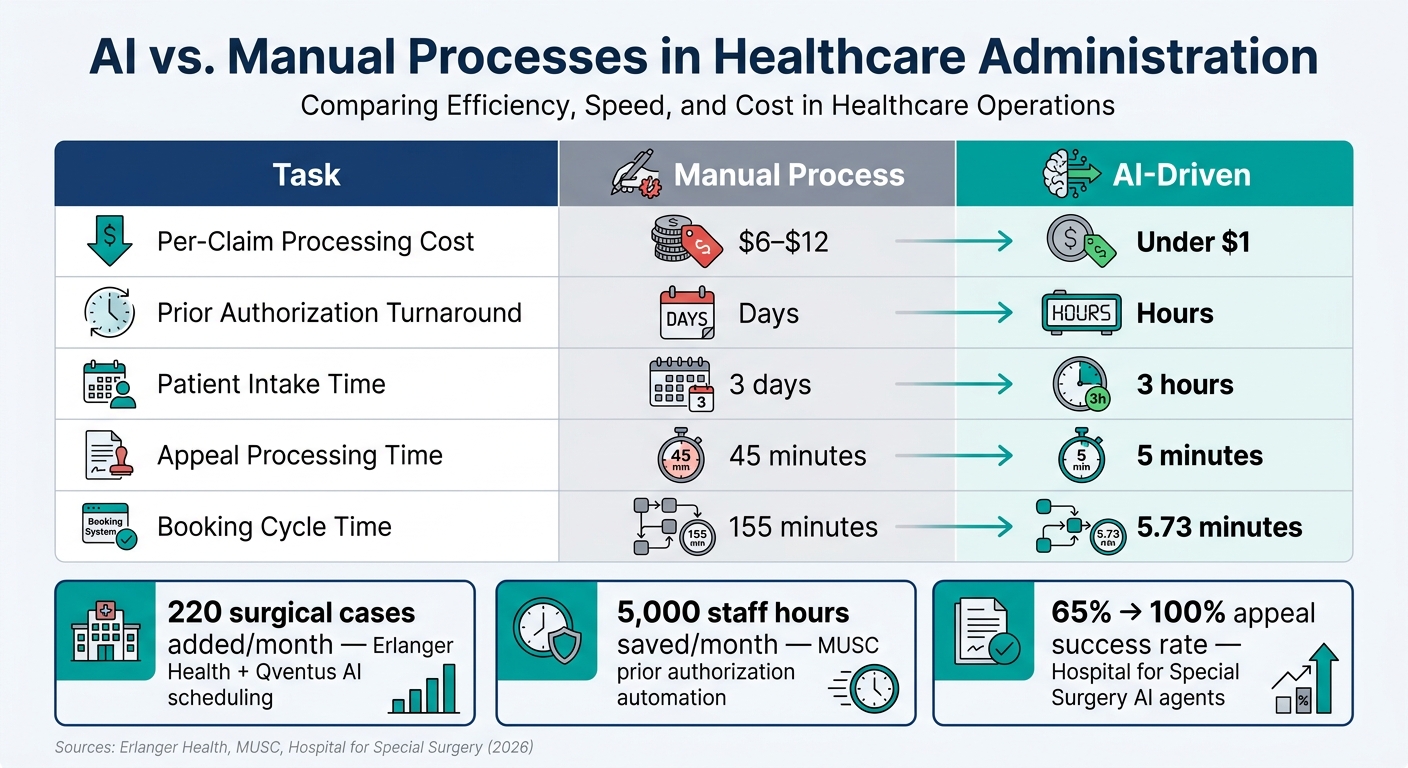
AI vs. Manual Processes in Healthcare Administration
As healthcare continues to evolve, AI is stepping in to reshape not just clinical care but also the behind-the-scenes operations that keep the system running. Tasks like scheduling, billing, compliance, and paperwork - essential but time-consuming - are becoming more efficient with AI. Considering administrative costs make up about **25% of U.S. healthcare spending**, AI's ability to streamline these processes is starting to make a noticeable difference.
### Automating Scheduling and Workflow Management
Traditional scheduling systems often struggle to adapt to real-world disruptions, such as last-minute cancellations or physician availability. AI brings a new level of flexibility and precision to these systems, making scheduling smarter and more responsive.
Take **[Erlanger Health System](https://www.erlanger.org/)**, for example. In February 2026, they teamed up with [Qventus](https://www.qventus.com/) to implement an AI-powered surgical scheduling tool. Within just six months, this tool helped add **220 surgical cases per month** and boosted robotic surgical volume by **25%** by matching available operating room (OR) slots with surgeon schedules. A clinic scheduler at Erlanger highlighted the immediate impact:
> "Before Qventus, I was on the phone constantly trying to track down OR availability. Now I can see what's open in seconds and get cases scheduled in just a few minutes." - Clinic Scheduler, Erlanger Health System
Similarly, **[AtlantiCare](https://www.atlanticare.org/)** utilized [Opmed.ai](https://www.opmed.ai/) across more than 50 operating rooms starting in January 2026. The system achieved a **90% success rate** in recommending the release of unused surgical blocks and reduced overestimations in case lengths by **40%**. Meanwhile, **[UnityAI](https://www.unityai.co/solutions)** introduced its "StaffOps" platform in April 2026 across 120 care sites. This platform uses live EHR data to adjust staffing in real time, aligning workforce schedules with actual patient flow and cancellations instead of static shift plans.
> "Our belief is that what providers bring to the market is time for a patient in a place with a clinician, and, if you get that right, everything else happens." - Edmund Jackson, CEO, UnityAI
### Cutting Down on Administrative Work
Doctors often spend **15–20 hours a week** on non-clinical tasks, and AI is helping reclaim that time by automating documentation and prior authorization processes.
For instance, the **Mayo Clinic** introduced "VoiceCare AI" in June 2026 within its neurology and pediatrics departments. This system autonomously handles benefit verification and prior authorization calls, navigating insurance phone systems and updating EHRs without human input. It achieves an **87–90% autonomous call completion rate**. Similarly, the **[Medical University of South Carolina](https://www.musc.edu/) (MUSC)** saved **5,000 staff hours per month** by automating prior authorization submissions.
On the insurance claims front, the **[Hospital for Special Surgery](https://www.hss.edu/) (HSS)** in New York deployed AI agents in June 2026 to handle **1,100 claims per month**. The results were striking: appeal processing time dropped from **45 minutes to just 5 minutes**, and the appeal success rate jumped from **65% to 100%** over nine months. Dr. Ashis Barad, HSS's Chief Digital and Technology Officer, emphasized the broader impact:
> "We're spending so much time on keyboards and computers right now that we're actually not doing what we should be doing. This is going to rehumanize health care." - Ashis Barad, MD, Chief Digital and Technology Officer, Hospital for Special Surgery
Here’s a quick comparison of how AI stacks up against manual processes for common administrative tasks:
| Task | Manual | AI-Driven |
| --- | --- | --- |
| Per-claim processing cost | $6–$12 | Under $1 |
| Prior authorization turnaround | Days | Hours |
| Patient intake time | 3 days | 3 hours |
| Appeal processing time | 45 minutes | 5 minutes |
| Booking cycle time | 155 minutes | 5.73 minutes |
These advancements don’t just save time and money - they also improve staff morale. By automating routine tasks, healthcare workers can save **5 to 10 hours per week**, reducing burnout and turnover.
## Data Privacy and Governance in Healthcare AI
As AI continues to transform clinical care and healthcare operations, keeping data privacy and governance at the forefront is essential. While AI fuels advancements in healthcare, it also introduces serious privacy concerns. Healthcare alone accounts for **43.38% of all data breaches** across industries, highlighting the urgency of addressing these risks. Traditional security measures often fall short in managing the complexities brought by AI's rapid adoption.
### Protecting Patient Data
The Health Insurance Portability and Accountability Act (HIPAA) requires that AI tools handling Protected Health Information (PHI) comply with its Security Rule standards. However, AI's ability to cross-reference anonymized data with other datasets poses a growing risk of re-identification. A 2025 review revealed that **38.4% of studies** using PHI for large language model development failed to disclose whether they implemented data protection measures - a concerning statistic, especially since **55.2% of such studies** in healthcare were published in 2025.
Vendor compliance is another weak point. While **66% of U.S. physicians** rely on AI tools, only **23% of health systems** have Business Associate Agreements (BAAs) in place to regulate PHI use with third-party vendors. These agreements must clearly define how vendors handle PHI, including its use in model training and de-identification. As Morgan Lewis notes, "PHI cannot be analyzed through publicly available AI models".
Below is a table outlining protection strategies based on data sensitivity:
| Sensitivity Level | Data Type | Recommended Protection |
| --- | --- | --- |
| **Critical** | Genomic/Hereditary Data | Homomorphic encryption to protect raw data during analysis |
| **High** | EHR, Mental Health Records | Identity and access management (IAM) and immutable audit trails |
| **Medium** | Wearable/IoT Data | Differential privacy to prevent record linkage |
| **Standard** | Billing/Administrative | AES-256 encryption and logical data separation |
Recent cyberattacks underscore the need for stronger protections. For instance, a breach at Change Healthcare in February 2024 exposed **190 million health records**, while Yale New Haven Health suffered a breach affecting over **5.5 million records** in March 2025. These incidents led to costly legal and financial repercussions.
But safeguarding data isn’t enough. Effective governance is just as critical to ensure AI systems are transparent, reliable, and accountable.
### Oversight and Accountability in AI Systems
Establishing proper oversight is key to making AI decisions explainable, auditable, and correctable. Unfortunately, many healthcare organizations deploy AI without adequate governance, leading to what the Health Sector Coordinating Council (HSCC) calls "black box" decision-making:
> "Without proper AI governance, AI systems can leak data, disrupt operations, perpetuate biases, adversely affect populations, or fail catastrophically." - Health Sector Coordinating Council (HSCC)
For example, a sepsis prediction model failed to identify two-thirds of cases while frequently generating false positives. Without ongoing monitoring, such performance issues can go unnoticed, jeopardizing patient care.
One practical solution is forming a cross-functional AI governance committee. This team should include physician leaders, IT and security experts, legal advisors, and patient advocates. The committee can ensure all AI tools are formally registered, addressing the problem of "shadow AI" - unauthorized tools operating outside institutional oversight. Alarmingly, **71% of healthcare workers** use personal AI accounts for work, and **81% of data policy violations** in healthcare involve HIPAA-regulated data.
For organizations looking to evaluate their preparedness, the Healthcare AI Governance Readiness Assessment (HAIRA) model provides a five-level maturity scale. This ranges from basic exploratory use (Level 1) to fully integrated continuous improvement (Level 5). However, only **50% of U.S. hospitals** using predictive models assess them for bias, and just **66% evaluate their accuracy**. Running new AI tools in a "shadow deployment" phase - where they operate alongside existing workflows without affecting outcomes - is a smart way to identify and fix performance or bias issues before they impact patient care.
## A Step-by-Step Guide to Implementing AI in Healthcare
Once governance and data protection measures are established, the next step is a structured rollout plan. This is where many healthcare organizations falter, as skipping essential planning often leads to failure in scaling AI solutions. Despite healthcare seeing an **average ROI of 150% from AI investments**, it has the lowest conversion rate from pilot to production among major industries - just **14%**. Bridging this gap requires careful preparation and execution.
### Evaluating Your Systems and Identifying Opportunities
Start by pinpointing a specific challenge, such as excessive documentation or delays in obtaining authorizations. Defining the problem helps focus efforts and informs decision-making.
A **data readiness audit** is crucial to ensure your data is structured, standardized (using formats like FHIR, LOINC, and SNOMED CT), and accessible. While **96% of U.S. hospitals** now use certified EHR systems, fragmented systems often remain a hurdle.
When deciding which use cases to prioritize, many leading health systems take a tiered approach:
- **60% on administrative tasks** (e.g., scheduling, billing)
- **30% on workflow optimization**
- **10% on diagnostic or predictive tools**
Administrative AI solutions, such as automating prior authorizations or medical coding, often deliver **200–400% ROI within a year** and involve fewer regulatory hurdles than clinical tools. On the other hand, diagnostic tools may take **12–24 months** to secure FDA clearance.
> "The sector has identified over 50 viable AI applications, but only 8–12 have reached production scale in leading health systems." - Bartek Pucek, The Thinking Company
To make informed decisions, use a practical scoring system. Rate potential use cases on a **1–5 scale** across three weighted factors: **Clinical Impact (40%)**, **Operational Efficiency (35%)**, and **Regulatory Feasibility (25%)**. This ensures prioritization is based on measurable value rather than hype.
Once you've selected your use cases, the focus shifts to preparing your team for smooth integration.
### Training Staff and Updating Workflows
Successful AI adoption starts with mapping workflows. Identify where AI outputs will appear during the clinical day and embed them directly into the EHR to avoid creating extra steps. Clinicians are far less likely to use tools that require switching between systems.
Change management is just as important as technical integration. Engage clinical champions to advocate for the tool, explain its purpose, and address concerns about liability or job security. For example, in April 2026, [Duke Health](https://www.dukehealth.org/) used a team of on-site nurses to triage sepsis detection alerts before they reached physicians, reducing alert fatigue and ensuring the AI was used appropriately.
Training should be an ongoing process, not a one-time event. Staff need to understand the tool's limitations, learn how to identify performance issues, and know their role in overriding AI recommendations when necessary. Tools like "Model Facts" cards, which summarize a model's purpose, training data, and risks, can help keep staff informed.
### Tracking Results and Refining Over Time
With systems in place and staff trained, monitoring becomes the key to long-term success. Define success metrics before signing vendor contracts. Effective monitoring should focus on three areas:
- **Statistical performance** (e.g., accuracy, sensitivity, specificity)
- **Patient outcomes** (e.g., readmission rates, length of stay)
- **User adoption** (e.g., alert fatigue, click-through rates, time-to-note completion)
Set performance thresholds that trigger reviews if crossed. For instance, if **80–90% of high-risk alerts are ignored**, the model is failing the workflow. As noted by the [Institute for Healthcare Improvement](https://www.ihi.org/):
> "If a care team receives 10 high-risk alerts in a week and only one or two of those patients get readmitted, the team will quickly learn to ignore the alerts. The model becomes noise rather than signal."
Real-world examples highlight the importance of monitoring. [St. Michael's Hospital](https://unityhealth.to/locations/st-michaels-hospital/) in Toronto used the **CHARTWatch** AI system to reduce ICU escalations by over **20%**, saving an estimated **100 lives annually** by predicting patient deterioration. Similarly, [Vanderbilt Health](https://www.vanderbilthealth.com/) introduced **VAMOS** (Vanderbilt Algorithmovigilance Monitoring and Operations System) in April 2026, a dashboard that tracks over **300 approved AI models** for issues like accuracy variation by race and model drift. This system allows for timely human intervention before clinical outcomes are affected.
Continuous refinement is essential. Regularly audit model performance across demographic groups, track clinician overrides, and implement a **Predetermined Change Control Plan (PCCP)** - an FDA-recognized framework that enables algorithm updates without requiring new clearances for every iteration.
## Conclusion: What Lies Ahead for AI in Healthcare
AI is shifting from being a collection of isolated tools to becoming a network of interconnected, autonomous systems. By 2030, the global healthcare AI market is expected to hit **$187 billion**. This growth is fueled by advancements like digital twins that simulate treatments before application, AI-CRISPR combinations for personalized cancer therapies, and agentic systems capable of managing entire care coordination workflows.
This transformation feels different from previous technological waves. As Dr. John D. Halamka, President of [Mayo Clinic Platform](https://www.mayoclinicplatform.org/), aptly said:
> "We happen to be in exactly the right place at exactly the right time, when the world decided that AI was what we needed to transform medicine."
However, technology alone won’t shape the future - it’s about governance. As of 2026, only **27% of physicians and nurses** report awareness of formal AI governance policies in their organizations, and **74% of clinicians** express concerns about relying too heavily on AI to catch its own mistakes. These aren’t technical hurdles; they’re leadership challenges. Addressing them requires a strategic shift in how organizations approach AI.
The true leaders in this space won’t necessarily be those with the most cutting-edge algorithms. Instead, they’ll be the ones following the **10-20-70 rule**: dedicating 10% of their focus to algorithms, 20% to data and technology, and 70% to people and processes. As the [Vector Institute](https://vectorinstitute.ai/) put it:
> "The question for healthcare leaders is no longer if they will adopt AI, but how they will govern it."
Moving forward, organizations need a deliberate strategy. Start with applications that offer high impact but come with low risks. Establish governance frameworks before scaling up. Commit to continuous staff training. Treat every AI deployment as an evolving system that demands constant oversight, not a one-and-done solution. The tools are ready - now it’s up to organizations to integrate them with disciplined leadership and thoughtful governance.
## FAQs
### What healthcare tasks should AI tackle first?
Healthcare providers can benefit greatly by targeting AI applications that lighten administrative tasks while ensuring human oversight for more nuanced decisions. Some high-impact areas to consider include:
- **Ambient clinical documentation**, which helps draft encounter notes automatically.
- Automating prior authorization by collecting and organizing clinical evidence.
- Using medical coding copilots to generate CPT and ICD-10 codes for human review.
These use cases are particularly effective because they rely on established policies, are well-documented, and have straightforward criteria for measuring success.
### How can hospitals validate AI safety and accuracy over time?
Hospitals ensure the safety and accuracy of AI systems by closely monitoring them even after they've been deployed. Since clinical data and patient demographics can shift over time, performance may drop, making a structured quality assurance process essential. This involves keeping an eye on data drift, comparing AI predictions to actual clinical outcomes, and establishing clear performance benchmarks. By assigning dedicated staff to track metrics and defining specific triggers for reviewing or pausing a model, hospitals can ensure these tools consistently meet the required clinical standards.
### How can patient data stay HIPAA-safe when using AI vendors?
To keep patient data compliant with HIPAA when working with AI vendors, the first step is to sign a **Business Associate Agreement (BAA)** before handling any protected health information (PHI). While a BAA is required, it’s just the beginning. You’ll also need to conduct a **documented risk assessment** of your AI systems. Additionally, enforce the **minimum necessary standard**, which restricts access to only the PHI essential for the task. Finally, ensure that your contracts explicitly prohibit vendors from using your data to train their AI models.

Vishal Rewari
[#Information](https://optiblack.com/insights/tag/information)
/ Keep reading
## More from Optiblack
[-3.png) Case Studies From Zero to a Multi-Region Analytics Backbone: How OptiBlack Built Scrut's Entire Data Platform](https://optiblack.com/insights/from-zero-to-a-multi-region-analytics-backbone-how-optiblack-built-scruts-entire-data-platform) [-4.png) Information AI in Geographic Segmentation: Key Use Cases](https://optiblack.com/insights/ai-geographic-segmentation-key-use-cases) [-3.png) News RealBooks Selects Optiblack as Strategic Analytics Partner to Build Modern Data Stack for Real Estate Investors](https://optiblack.com/insights/realbooks-selects-optiblack-as-strategic-analytics-partner-to-build-modern-data-stack-for-real-estate-investors)
/ 15-minute exploration call
## Turn these insights into revenue.
We'll go through your CRM, product, and analytics data together and show you exactly where growth is leaking. No setup. No dashboards. Just signal.
[Book a strategy call →](https://optiblack.com/book-a-call)
[OPTIBLACK](https://optiblack.com/)
US: 1309 Coffeen Ave, Suite 1200, Sheridan, WY 82801 · +1 682 297 2970 — India: 297 Designs, 74 SBK Society, Paldi, Ahmedabad 380007 · +91 9819394297
Services
[Data services](https://optiblack.com/services) [CRM services](https://optiblack.com/services) [AI services](https://optiblack.com/services) [Book a call](https://optiblack.com/services)
Company
[Customers](https://optiblack.com/customers) [About Us](https://optiblack.com/about-us) [Insights](https://optiblack.com/insights)
© 2026 Optiblack · 2× Mixpanel Partner of the Year · vishal@optiblack.com
```json
{
"@context" : "https://schema.org",
"@type" : "BlogPosting",
"author" : {
"@type" : "Person",
"name" : "Vishal Rewari",
"url" : "https://optiblack.com/insights/author/vishal-rewari"
},
"dateModified" : "2026-07-09T08:32:26.495Z",
"datePublished" : "2026-07-09T08:32:26.000Z",
"headline" : "Healthcare AI: Diagnostics & Operations",
"image" : [ "https://optiblack.com/hubfs/Optiblack%20Vishal%20Rewari%20Product%20Analytics%20(7)-4.png" ],
"mainEntityOfPage" : {
"@id" : "https://optiblack.com/insights/ai-in-healthcare",
"@type" : "WebPage"
},
"publisher" : {
"@type" : "Organization",
"logo" : {
"@type" : "ImageObject",
"url" : "https://optiblack.com/hubfs/Group%201234.png"
},
"name" : "Optiblack"
}
}
```
```json
{
"@context" : "https://schema.org",
"@type" : "FAQPage",
"mainEntity" : [ {
"@type" : "Question",
"acceptedAnswer" : {
"@type" : "Answer",
"text" : "Healthcare providers can benefit greatly by targeting AI applications that lighten administrative tasks while ensuring human oversight for more nuanced decisions. Some high-impact areas to consider include:
Ambient clinical documentation , which helps draft encounter notes automatically.Automating prior authorization by collecting and organizing clinical evidence. Using medical coding copilots to generate CPT and ICD-10 codes for human review. These use cases are particularly effective because they rely on established policies, are well-documented, and have straightforward criteria for measuring success.
"
},
"name" : "What healthcare tasks should AI tackle first?"
}, {
"@type" : "Question",
"acceptedAnswer" : {
"@type" : "Answer",
"text" : "Hospitals ensure the safety and accuracy of AI systems by closely monitoring them even after they've been deployed. Since clinical data and patient demographics can shift over time, performance may drop, making a structured quality assurance process essential. This involves keeping an eye on data drift, comparing AI predictions to actual clinical outcomes, and establishing clear performance benchmarks. By assigning dedicated staff to track metrics and defining specific triggers for reviewing or pausing a model, hospitals can ensure these tools consistently meet the required clinical standards.
"
},
"name" : "How can hospitals validate AI safety and accuracy over time?"
}, {
"@type" : "Question",
"acceptedAnswer" : {
"@type" : "Answer",
"text" : "To keep patient data compliant with HIPAA when working with AI vendors, the first step is to sign a Business Associate Agreement (BAA) before handling any protected health information (PHI). While a BAA is required, it’s just the beginning. You’ll also need to conduct a documented risk assessment of your AI systems. Additionally, enforce the minimum necessary standard , which restricts access to only the PHI essential for the task. Finally, ensure that your contracts explicitly prohibit vendors from using your data to train their AI models.
"
},
"name" : "How can patient data stay HIPAA-safe when using AI vendors?"
} ]
}
```