AI-powered sentiment tracking is transforming how businesses understand customer emotions. By processing data in seconds, it replaces slow, manual methods that take hours. This means companies can respond faster, improve customer satisfaction, and boost retention rates. AI also analyzes vast amounts of data across multiple platforms, delivering more accurate insights than traditional methods.
Key Takeaways:
- Speed: AI reduces analysis time by 94%, completing tasks in minutes.
- Accuracy: Advanced models like GPT handle complex language nuances better than manual systems.
- Scalability: AI covers 100% of interactions, unlike manual sampling.
- Business Impact: Faster responses lead to higher customer retention and revenue growth.
AI is changing the game for businesses, offering real-time, actionable insights that manual methods simply can’t match.
1. AI-Driven Real-Time Sentiment Tracking
Speed and Responsiveness
AI has revolutionized sentiment tracking, cutting down the process from a lengthy 4-step, 2–6-hour manual workflow to a swift 2-step, 10-minute automated system - a staggering 94% time savings. With low-latency processing, AI can analyze live data and refresh dashboards within seconds or minutes, keeping teams updated in real time.
Take, for example, a major U.S. telecom company in 2024. During a live-streamed product launch, they used real-time AI sentiment analysis to monitor audience reactions. This allowed the team to adjust the host's script and product demonstrations on the fly, which led to a 22% increase in positive sentiment and a 15% boost in live sales. Automated alerts integrated into the workflow ensured that sentiment shifts were addressed within minutes.
Accuracy and Context
AI models like Recurrent Neural Networks and Transformer-based systems such as BERT and GPT excel at capturing complex linguistic patterns, including sarcasm, ambiguity, and nuanced context - areas where traditional keyword-based systems often fall short. These systems also weed out bots, duplicate content, and unreliable sources, ensuring that the sentiment analysis reflects real human emotions rather than noise.
What’s more, AI can map sentiment spikes to specific moments, such as a keynote speech or a product announcement, providing crucial context behind emotional shifts. Companies using advanced AI sentiment platforms have reported a 30% improvement in their ability to identify and address negative feedback in real time. This level of precision enables businesses to act faster and with greater confidence.
Scalability and Coverage
Modern AI systems can now analyze 100% of interactions in real time. Platforms like Apache Kafka and AWS Kinesis process massive streams of data from diverse sources, including social media platforms (X, Instagram, Facebook, LinkedIn), review sites (Google Reviews, Yelp, TripAdvisor), forums (Reddit), support tickets, emails, and even live voice calls.
Netflix provides a great example of this in action. By combining real-time sentiment signals - like how often users fast-forward - with explicit feedback, Netflix fine-tunes its recommendations. This approach boosted click-through rates by 30% and reduced mid-session abandonments by 10% as of 2025. Similarly, T-Mobile's use of AI sentiment analysis in 2024 reduced customer complaints by an impressive 73%. Advanced optimization techniques, such as quantization and GPU acceleration, allow these AI models to handle millions of events in real time with latency under 200 milliseconds.
By combining speed, accuracy, and scalability, these advancements are delivering measurable results across industries.
Business Impact
"A real-time sentiment pipeline captures social chatter, in-app reactions, and viewer cues like pauses or rewinds every 30 to 60 seconds. AI models score these inputs to create a continuous mood index. When sentiment spikes or dips, we can respond in minutes instead of weeks."
– Ryan K. McDonald, Product Leader
The business potential of real-time sentiment tracking is clear. During an NFL pilot program, DraftKings integrated game data with real-time social sentiment to offer personalized betting opportunities within just 100 milliseconds of thrilling plays. This strategy drove a 12% increase in live-bet conversions and a 7% rise in average wager sizes. Meanwhile, NBCUniversal used sentiment data to strategically time ad breaks during a Peacock streaming trial. The result? Double-digit improvements in ad viewability and a nearly 20% increase in overall watch time.
These examples highlight how AI-driven sentiment tracking is reshaping industries by enabling faster decisions and more personalized experiences.
sbb-itb-18d4e20
2. Manual Sentiment Tracking Methods
Speed and Responsiveness
Manual sentiment tracking is notoriously time-consuming. Processing even a relatively small dataset - like 5,000 comments - can take anywhere from 2 to 4 hours, whereas automated tools can handle the same workload in just 15 minutes. Larger datasets only amplify these delays, making manual workflows sluggish and impractical in fast-paced environments.
This lag forces many brands to rely on weekly or monthly reports, which means they’re often reacting after the fact. In the world of social media, where trends and crises can emerge in the blink of an eye, these delays leave businesses struggling to keep up.
Accuracy and Context
One advantage of human analysts is their ability to pick up on subtleties like sarcasm, irony, and nuanced cultural references. However, interpretations can vary widely among individuals, especially under pressure or when dealing with high volumes of data.
"While humans can spot sarcasm from a mile away, machines don't always process it as easily."
– Jack Kosakowski, VP of GTM, Nextiva
Static lexicons used in manual tracking add another layer of complexity. These lexicons require frequent updates to stay relevant, and human fatigue further reduces reliability when large amounts of data need to be processed.
Scalability and Coverage
Manual sentiment tracking falls short when it comes to scaling. Limited sampling is often unavoidable, leading to incomplete sentiment profiles that can distort decision-making.
The problem becomes even more pronounced when businesses need to monitor multiple channels - social media, review sites, support tickets, forums - all at once. Unlike AI systems that can analyze every interaction without breaking a sweat, manual methods force teams to choose between covering a wide range of platforms or diving deep into specific ones. This trade-off highlights the stark contrast between manual methods and AI's ability to provide comprehensive, real-time insights.
Business Impact
Manual tracking doesn’t just slow things down; it actively hinders strategic decision-making. Delayed responses mean missed opportunities to influence customer behavior. Considering that emotional factors drive 70% of purchase decisions, being too late to act can have serious consequences.
"Traditional methods just don't cut it anymore."
– Nurix AI
Additionally, manual processes often scatter insights across multiple files and platforms, making it difficult for teams to collaborate or create unified strategies. Instead of focusing on actionable insights, teams end up wasting time organizing and interpreting fragmented data. In fast-moving markets, this inefficiency can put businesses at a significant disadvantage. These challenges explain why so many companies are turning to AI for faster, more cohesive sentiment analysis.
Sentiment Analysis in Action w Flink: Building Real-time Pipelines (O. Kutsenko, Aiven) Current 24
Advantages and Disadvantages
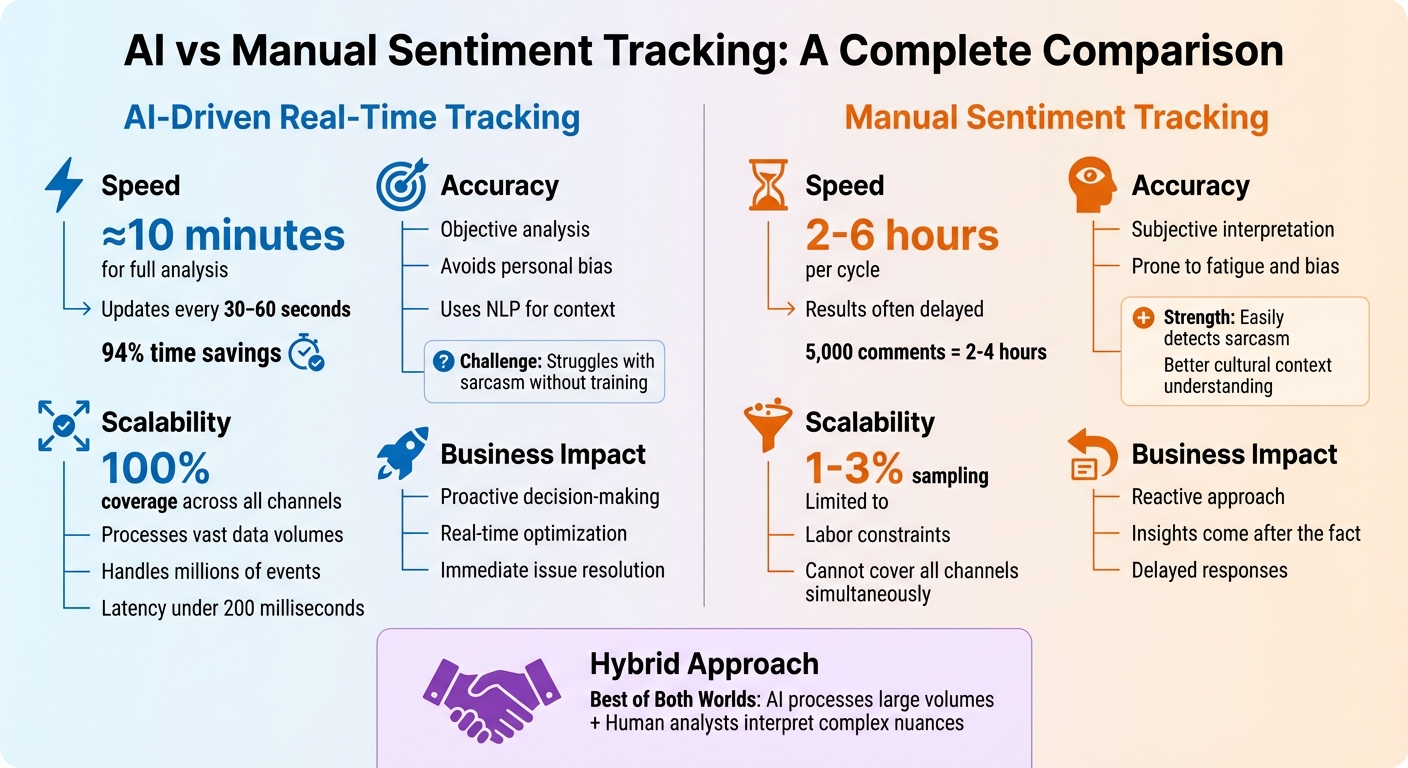
AI vs Manual Sentiment Tracking: Speed, Accuracy, and Scalability Comparison
When comparing AI-driven and manual sentiment tracking, the differences in speed, accuracy, scalability, and overall business impact become clear. Each method has its own strengths and weaknesses, shaping how effectively you can capture and respond to customer sentiment.
AI systems are incredibly efficient, cutting down analysis workflows to mere seconds. They can provide updates every 30 to 60 seconds, offering a live feed of customer sentiment that allows for quick strategy shifts. In contrast, manual methods often require several hours to produce insights, which means the window to address a customer interaction may already have closed. However, AI does have its limits - it often struggles with detecting sarcasm and irony unless extensively trained. Human analysts, on the other hand, naturally pick up on these subtleties and are better equipped to understand cultural context.
Scalability is another area where AI shines. AI-driven systems can analyze 100% of interactions across all channels, handling enormous amounts of unstructured data. Manual tracking, however, typically relies on random sampling, covering only 1–3% of interactions. This leaves significant gaps in understanding customer sentiment. Additionally, manual analysis is susceptible to analyst fatigue and subjective bias, whereas AI consistently applies its models, reducing the risk of individual interpretation errors.
The business impact of these methods highlights their contrasting approaches. AI enables proactive decision-making, allowing businesses to address issues in real time and prevent customer disengagement. Manual methods, by nature, are reactive - providing insights only after the fact. The table below highlights these differences for a quick overview:
| Feature | AI‑Driven Real‑Time Tracking | Manual Sentiment Tracking |
|---|---|---|
| Speed | ~10 minutes for full analysis; updates every 30–60 seconds | 2–6 hours per cycle; results often delayed |
| Accuracy | Objective; avoids personal bias; uses NLP for context | Subjective; prone to fatigue and bias |
| Scalability | High; processes vast data with 100% coverage across channels | Low; limited to 1–3% sampling due to labor constraints |
| Business Impact | Proactive; enables real-time optimization and issue resolution | Reactive; insights come after the fact |
| Nuance Detection | Struggles with sarcasm and irony without extensive training | Easily detects sarcasm and understands cultural context |
Interestingly, many organizations opt for a hybrid approach. By using AI to process large volumes of data and flag urgent issues, businesses can leverage its speed and scale while relying on human analysts to interpret complex nuances and ensure the brand’s voice remains consistent. This blend of technology and human expertise allows companies to gain the best of both worlds: rapid, scalable insights alongside the detailed understanding that only humans can provide. Ultimately, AI's ability to deliver timely, accurate, and broad insights has a direct influence on business outcomes.
Conclusion
AI-powered sentiment tracking is reshaping how businesses understand and respond to customer emotions. By cutting analysis time by a staggering 94%, AI allows companies to act on customer feedback with unmatched speed and accuracy. Compared to the sluggish pace of manual tracking, this technology offers a game-changing advantage. Real-world examples show how these efficiencies translate into measurable business growth and improved decision-making.
Unlike traditional, piecemeal approaches, AI leverages Natural Language Processing (NLP) to provide objective, real-time insights. This means businesses can quickly adjust their strategies - whether it’s tweaking content, fine-tuning ad campaigns, or enhancing user experiences - all based on live emotional feedback.
That said, AI isn’t without its quirks. It can stumble when interpreting sarcasm or idiomatic expressions, but even with these occasional hiccups, it delivers consistent insights at scale. These reliable insights not only simplify operations but also empower businesses to make smarter, data-driven choices.
For companies eager to tap into these benefits, Optiblack offers a clear path forward. Their AI Initiatives and Data Infrastructure services are designed to help SaaS, eCommerce, Fintech, and Hospitality businesses implement and scale sentiment analysis. With Optiblack, businesses can unlock operational efficiencies and gain a deeper, real-time understanding of their customers.
FAQs
How does AI make sentiment tracking more accurate than manual methods?
AI uses natural language processing (NLP) and advanced machine learning to break down and understand language patterns across massive datasets in real time. While traditional methods can be inconsistent and influenced by human error, AI provides a more dependable and unbiased approach to sentiment analysis by removing personal biases from the equation.
With the ability to process enormous volumes of data both quickly and consistently, AI generates accurate sentiment scores. These insights enable businesses to make swift, informed decisions based on data. This combination of speed and precision makes AI an essential tool for industries like SaaS, eCommerce, and Fintech, helping them better grasp customer emotions and refine their engagement strategies.
What makes sarcasm and irony difficult for AI to understand in sentiment analysis?
Sarcasm and irony present a tough puzzle for AI in sentiment analysis because the literal meaning of words often clashes with the speaker's actual intent. Take, for instance, the phrase “Great, another meeting!” - while it might sound positive on the surface, it's almost certainly laced with frustration. Traditional methods tend to falter here since they focus on the words themselves rather than the broader context.
To tackle this, modern AI models are designed to dig deeper, analyzing contextual cues like conversation history or user behavior to better decode intent. But sarcasm isn’t just about context - it thrives on subtleties like tone, shared experiences, or even inside jokes. These nuances are particularly hard for algorithms to pick up, especially in short formats like tweets or reviews. Adding to the challenge is the limited availability of sarcasm-specific, high-quality datasets for training.
Optiblack addresses these hurdles head-on by leveraging advanced transformer-based models that are fine-tuned with sarcasm-aware data. With a stronger grasp of context, Optiblack improves the precision and dependability of real-time sentiment analysis, making it a valuable tool for industries like SaaS, e-commerce, fintech, and hospitality.
How can businesses use AI for real-time sentiment tracking and decision-making?
Businesses can leverage AI-powered sentiment tracking to make quick, informed decisions by analyzing customer interactions across various channels like social media, reviews, chats, calls, and videos. These advanced AI systems can efficiently categorize interactions as positive, neutral, or negative, giving teams the ability to spot emotional trends and act immediately. This approach removes the delays of manual monitoring, delivering almost instant insights into how customers feel.
To make this work seamlessly, companies should:
- Integrate all relevant data sources into one system.
- Use a platform capable of processing data in real time with minimal delays.
- Employ a sentiment model specifically designed for their industry.
- Configure automated alerts or workflows, such as flagging negative feedback for immediate attention or tweaking marketing strategies based on sentiment shifts.
By using these tools, businesses can track customer sentiment in real time, fine-tune marketing efforts, enhance product experiences, and address potential problems before they grow. Optiblack’s AI Initiatives service offers the expertise and infrastructure needed to transform sentiment data into actionable strategies, helping organizations stay ahead of customer needs.