-4.png)
AI-powered workflow orchestration simplifies complex processes by connecting tools, data, and AI models to automate tasks across multiple steps. Unlike rigid rule-based systems, it uses flexible logic to adapt to real-time factors, making operations more efficient and scalable.
Key takeaways:
- Market Growth: Expected to grow from $16.16 billion (2024) to $42.76 billion (2035).
- Efficiency Boost: Cuts human errors by 90% and accelerates tasks (e.g., reducing invoice processing from 3 days to 4 hours).
- Industries: Especially useful for SaaS and Fintech, where companies often manage 130+ SaaS apps.
- Real-World Impact: UK government recovered $670 million in fraud using AI (Oct 2025).
Core benefits include:
- Automation: Handles repetitive tasks and unstructured data.
- Scalability: Dynamically allocates resources and evolves with new data.
- Error Handling: Self-healing systems with retries and rollbacks.
To implement:
- Map Processes: Identify bottlenecks and repetitive tasks.
- Consolidate Data: Ensure clean, centralized data for AI models.
- Build AI Agents: Create specialized agents for specific tasks.
- Monitor and Scale: Use metrics like success rates and latency to optimize.
For SaaS and Fintech, orchestration ensures smoother operations, compliance, and better decision-making. Companies like Optiblack specialize in helping organizations design and deploy these systems, reducing costs and improving workflows.
AI Workflow Orchestration - Move Beyond Simple Prompts
sbb-itb-18d4e20
Benefits of AI-Powered Workflow Orchestration
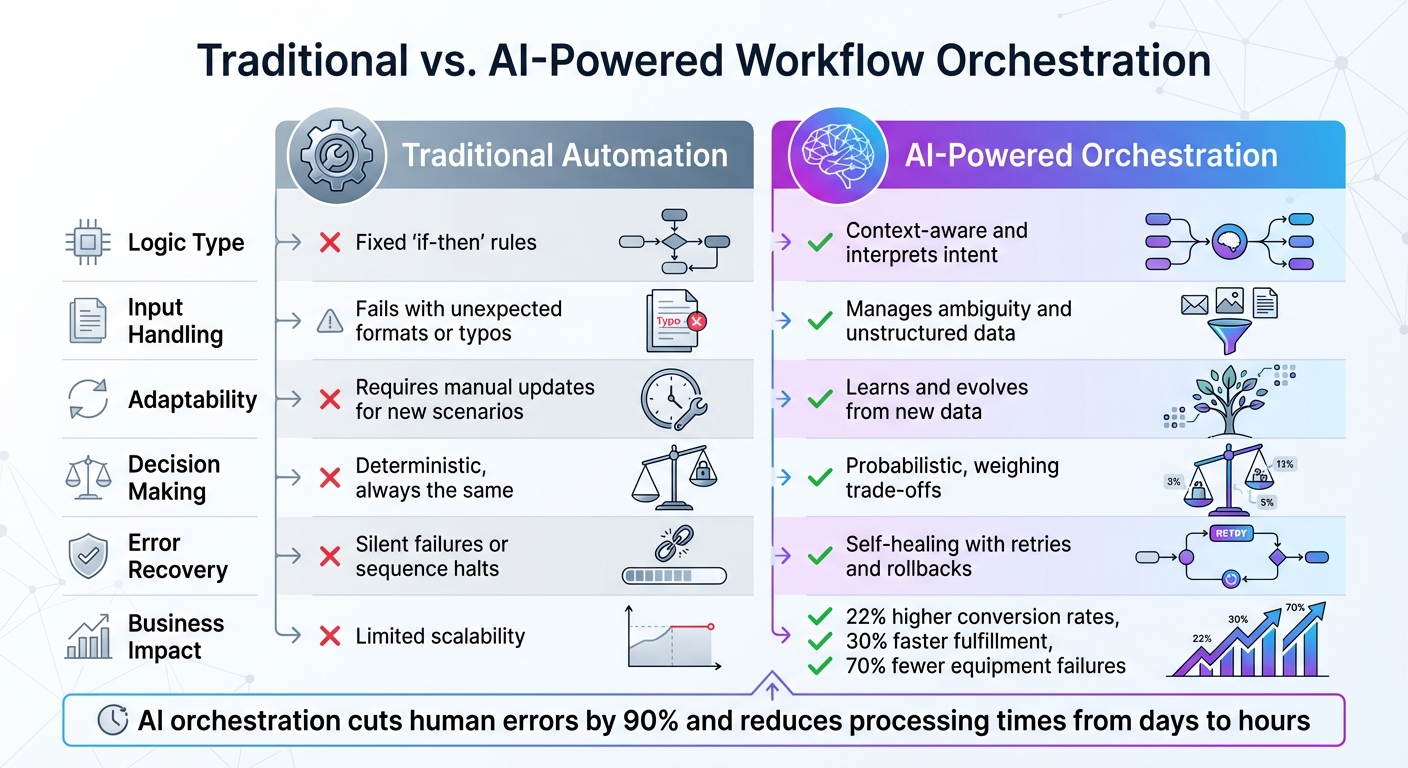
Traditional Automation vs AI-Powered Workflow Orchestration Comparison
AI-powered workflows are reshaping how businesses operate by acting as a central hub for orchestrating tasks. The results? Tangible improvements in efficiency, flexibility, and scalability.
Increased Efficiency Through Automation
AI orchestration takes over repetitive, error-prone tasks, especially when dealing with unstructured data like emails, PDFs, and messages - areas where traditional automation struggles. This ensures workflows stay on track, even when the input data isn't perfectly formatted.
The efficiency gains are hard to ignore. For example:
- Invoice processing times drop from 3 days to just 4 hours.
- Customer support response times shrink from 4 hours to under 2 minutes.
- Sales teams experience a 3x productivity boost when AI agents handle lead qualification.
A real-world example? In October 2025, Sami.Bot teamed up with Optiblack to create a system that monitors ad campaigns around the clock. It automatically scales successful ads and pauses underperformers, saving performance marketers over 10 hours of manual work each week.
The reduction in errors is equally striking. AI-powered workflows can cut human error by more than 90%. They also provide a safety net with features like financial thresholds, compliance checks, and system state monitoring. When probabilistic AI isn't enough, these workflows include retry logic, compensation steps, and rollback conditions to prevent unnoticed failures in complex systems like ERP or financial platforms.
"The role of orchestration is to place AI where it adds value and remove it where certainty matters more than creativity." - APIWORX
Better Scalability and Flexibility
One standout feature of AI-powered workflows is their ability to adapt to changing business needs without constant tweaking. Unlike traditional automation, AI thrives on ambiguity and evolves by learning from new data. This adaptability is crucial during high-stakes situations like financial audits, vendor delays, or end-of-quarter spikes in activity.
AI orchestration enables:
- Dynamic resource allocation: For instance, it can shift computing power based on real-time signals like payment confirmations or inventory updates, optimizing performance while keeping cloud costs in check .
In February 2025, SaaSflows CEO Nicolas Guillard collaborated with Optiblack to develop an AI agent tailored for Chief Financial Officers. This agent integrates with ERP systems to automate financial reporting and offer real-time predictive analytics, easing the workload for finance teams in the SaaS industry. As Vishal Rewari, Founder of Optiblack, explained: "This AI agent will provide CFOs with the tools they need to navigate the complexities of financial management with confidence and precision".
To maintain trust, AI-powered workflows often incorporate human-in-the-loop features. This means low-confidence decisions or critical exceptions are directed to human experts, ensuring accountability in regulated industries without creating unnecessary delays.
Traditional vs. AI-Orchestrated Workflows
When comparing traditional automation to AI-powered orchestration, the differences are striking:
| Feature | Traditional Automation | AI-Powered Orchestration |
|---|---|---|
| Logic Type | Fixed "if-then" rules | Context-aware and interprets intent |
| Input Handling | Fails with unexpected formats or typos | Manages ambiguity and unstructured data |
| Adaptability | Requires manual updates for new scenarios | Learns and evolves from new data |
| Decision Making | Deterministic, always the same | Probabilistic, weighing trade-offs |
| Error Recovery | Silent failures or sequence halts | Self-healing with retries and rollbacks |
E-commerce companies using AI orchestration have reported 22% higher conversion rates and 30% faster fulfillment cycles. In manufacturing, predictive maintenance powered by AI has led to 70% fewer equipment failures and a 25% drop in maintenance costs. These aren't small tweaks - they represent a complete transformation in how operations are managed.
Core Patterns and Components of AI Workflow Orchestration
Getting AI workflows right is critical for success in production. It's not just about the AI models themselves - 57% of enterprise AI project failures are tied to orchestration design, not individual agent performance.
Main Orchestration Patterns
Choosing the right orchestration pattern depends on your specific business needs. For straightforward, step-by-step processes, the Sequential Pipeline is ideal. Think of tasks like processing a scanned invoice: first, use OCR to extract text, then validate the data, and finally post it to your accounting system. For more complex workflows requiring dynamic task assignment, the Supervisor pattern shines. Here, a central orchestrator agent develops an execution plan, assigns tasks to specialized agents, and integrates their outputs.
When speed is a priority, the Parallel Fan-Out/Fan-In pattern allows multiple agents to tackle independent subtasks simultaneously. For example, a SaaS company analyzing customer feedback might send survey responses to separate agents for sentiment analysis, topic extraction, and urgency scoring, then combine the results. On the other hand, the Router pattern acts like a traffic controller, directing tasks to the right model or agent. In Fintech, this could mean routing simple balance inquiries to a lightweight model while sending fraud alerts to a more advanced system. This approach can cut LLM inference costs by 40% by using cheaper models like GPT-3.5-turbo ($0.002 per 1,000 tokens) for simpler tasks and reserving premium models like Claude 3 Opus ($0.075 per 1,000 tokens) for complex reasoning. One company managed to slash its monthly AI costs from $47,000 to $12,000 - a nearly 75% reduction - by implementing intelligent routing.
For tasks where quality is non-negotiable, such as code generation or compliance documentation, the Evaluator-Optimizer Loop is invaluable. It generates outputs, evaluates them against quality benchmarks, and iterates until the desired standard is achieved. For large-scale, multi-domain projects, the Hierarchical Delegation pattern works well. This creates a tree structure where high-level agents delegate to mid-level workstream agents, who then manage task-specific agents. A financial audit, for instance, might require coordination across legal review, data extraction, and report generation.
"AI orchestration isn't about picking the 'best' model. It's about using the right model for each specific task at the right time." - Oronts Engineering Team
To make these patterns work, robust workflow components are essential. These provide the backbone for implementing and managing complex orchestration strategies.
Required Workflow Components
For any AI workflow to function effectively, certain components must be in place. At the core is the Workflow Engine, which acts as the central controller, handling logic, dependencies, and task sequencing. Input Validation & Normalization is another critical piece, ensuring that malformed or malicious data doesn't disrupt the pipeline before it even reaches your models.
State Management is vital for maintaining process memory, tracking the status of tasks, and resuming interrupted workflows. This is especially important for long-running processes like loan applications or financial reconciliations. Then there's Model Selection Logic, which ensures that the most appropriate model is chosen based on factors like cost, latency, and capability. For instance, a customer support system might use GPT-4 for complex troubleshooting but rely on GPT-3.5 for simpler FAQ responses.
Resilience is key, and that's where Error Handling & Fallbacks come into play. These mechanisms include retry strategies with exponential backoff, circuit breakers to bypass failing services, and backup models to step in when primary systems hit rate limits.
| Component | Function | SaaS/Fintech Example |
|---|---|---|
| Request Classification | Routes tasks based on complexity and domain | Routing a "legal threat" ticket to a human while sending a "refund" ticket to an agent |
| Task Chaining | Connects discrete AI operations | Linking "Extract Data" to "Verify Compliance" to "Generate Report" |
| Fallback Manager | Ensures redundancy during interruptions | Keeping workflows running when rate limits are reached |
| State Management | Maintains context across steps | Tracking customer responses in a multi-step loan application process |
Most production pipelines include 4–6 stages, and using structured workflows with clear plan-execute-test-fix cycles can reduce AI-generated code errors by 60–80% compared to single-shot prompting. Systems using explicit routing criteria in Supervisor patterns also see a 31% improvement in task completion rates over those with implicit criteria.
"The difference between a prototype and a production system isn't the model you use. It's everything around the model." - Oronts Engineering Team
How to Implement AI Workflow Orchestration
Taking AI workflow orchestration from concept to reality requires careful planning and execution. The global workflow orchestration market is expected to grow from $16.16 billion in 2024 to around $42.76 billion by 2035, but achieving success means avoiding rushed rollouts and instead focusing on a methodical approach. With U.S. organizations using an average of 130 SaaS applications in 2023, streamlining and orchestrating workflows has become essential for smoother operations.
Step 1: Map Your Current Processes
Begin by documenting how workflows actually operate, not how you think they should. Dive into support tickets, emails, and CRM logs to uncover bottlenecks and inefficiencies. Questions like "What steps are often skipped?" and "Where do approvals get delayed?" can help you identify problem areas. Target workflows that are repetitive, rule-driven, high-volume, and prone to errors.
Create a collection of 20–200 real-world tasks - your "Golden Tasks" - to represent everyday scenarios. These will act as benchmarks for evaluating your orchestration efforts. Look for points where processes break down, such as stalled handoffs between teams or areas requiring manual intervention.
"Workflow orchestration is the practice of coordinating multiple, automated tasks across different systems to execute a complete, end-to-end business process. It's the conductor that transforms isolated automations into a symphony." - Rebecca Pearson
Start small by automating a single, high-impact manual process to demonstrate value. Plan for potential failures by incorporating retries, error alerts, and "dead-letter queues" for unresolved issues. Process mapping is the foundation of effective orchestration, and once this groundwork is laid, the next step is to centralize your data for better insights.
Step 2: Consolidate Your Data Sources
Centralizing your data ensures AI systems have consistent and reliable information. This involves three key stages: extraction (gathering data from platforms like Salesforce, Google Analytics, or Zendesk), transformation (cleaning and standardizing formats), and analysis (adding historical context before feeding data into AI models). Validation checks - such as file size limits, UTF-8 encoding, and JSON formatting - help avoid pipeline failures.
For example, in August 2025, Popl, a digital business card company, integrated lead data from HubSpot and Salesforce. They used over 100 automated workflows to centralize information in Google Sheets, enabling real-time AI-driven data enrichment. This change eliminated manual routing delays and saved the company $20,000 annually by replacing costly legacy systems.
Limit data access using a "least privilege" model with three tiers: Tier 1 for read-only, Tier 2 for supervised writes, and Tier 3 for restricted or sensitive information. When preparing long documents for AI processing, include overlapping sections (e.g., 200 tokens) to ensure no critical details are lost.
Optiblack's Data Infrastructure services specialize in helping SaaS and Fintech companies connect disparate systems and maintain high data quality throughout the orchestration process. With centralized data, you can move on to creating AI agents tailored to your workflows.
Step 3: Build and Deploy AI Agents
Once your data is clean and consolidated, focus on building AI agents designed for specific tasks. Use modular components that can scale as your needs grow. Apply guardrails to inputs and outputs to prevent policy violations, protect sensitive data, and ensure brand consistency before deployment.
In 2025, Metro Bank introduced lending agents by layering orchestration over their existing infrastructure. This approach allowed them to enhance lending decisions at key workflow points without altering core systems. Similarly, JPMorgan Chase launched the "Ask David" platform, which uses a "Supervisor-Worker" model. A central agent oversees specialized sub-agents for tasks like SQL queries, document retrieval, and analytics.
"Orchestration does not make agents smarter. It makes them governable. It defines how agents coordinate, where human approval occurs, how exceptions are handled, and how decisions can be traced end to end." - Changez Akram Mian, Towards AI
To maintain scalability without sacrificing control, reserve human oversight for critical decision points rather than every single step. Optiblack's AI Initiatives offer expertise in developing and integrating AI agents that align with governance and compliance requirements. Once deployed, these systems need ongoing monitoring to ensure their performance remains optimal.
Step 4: Monitor and Scale Your Workflows
After deployment, track key metrics to measure success, including success rate (aim for >99%), response latency (p95 <3 seconds), token usage, error rates, and business outcomes. Using distributed tracing tools like OpenTelemetry and unique Trace IDs can help pinpoint bottlenecks across multiple agents. Systems with distributed tracing have been shown to reduce mean time to resolution (MTTR) by 73%.
Set up tiered alerts to avoid overwhelming your team with unnecessary notifications. For instance, only trigger alerts for persistent issues, such as a success rate dropping below 95% for several minutes, rather than reacting to short-term fluctuations.
In 2025, Orbital AI reduced their monthly LLM costs by 64%, cutting expenses from $180,000 to $65,000. They achieved this through prompt compression, semantic caching with a 40% hit rate, and redirecting 60% of requests to more cost-effective models like GPT-3.5.
Keep your "Golden Tasks" updated and use them for regression testing whenever you modify prompts or workflows. Store logs strategically: keep "hot" logs accessible for seven days in tools like Elasticsearch, and archive older "cold" logs in S3 for compliance purposes. This balance ensures cost efficiency while maintaining utility. Enhanced observability can speed up debugging by 10x, cutting resolution time from two hours to just 12 minutes.
"AI agent observability is the practice of collecting metrics, logs, and traces from autonomous AI systems to understand their internal state and behavior in production." - Alex Rivera, VP of Engineering, Orbital AI
Best Practices for AI Workflow Orchestration
Building on the earlier steps for implementing AI workflow orchestration, these practices help ensure your system is both efficient and scalable. To maximize the potential of AI-powered orchestration, it's crucial to focus on thoughtful design, compliance standards, and expert execution.
Design Modular Workflows
Breaking workflows into smaller, reusable pieces is a smart way to eliminate single points of failure. By creating specialized sub-agents - like a Planner, Coder, or Reviewer - you can improve error detection and streamline processes. This division of labor ensures that each component focuses on its specific task, making the overall system more reliable.
Organizations that rely on reusable orchestration patterns report development cycles that are 3–5 times faster. Think of it like building with LEGO blocks: creating universal components such as "Create New User" or "Data Extraction" workflows means you can reuse them across various processes without duplicating effort. Teams adopting sub-agent architectures often see a 40–60% boost in output quality for intricate, multi-step tasks.
Another key practice is storing workflow states in external databases like Redis or PostgreSQL. This allows long-running processes to pick up where they left off if something goes wrong. Additionally, using message-passing or event-driven patterns between agents - rather than direct internal calls - ensures that changes to one agent won't disrupt the entire system. These structured workflows not only enhance error handling but also cut down on debugging time.
"Monolithic agents attempting all tasks fail at all tasks - specialization enables expertise, separation of concerns enables validation, and delegation enables parallelization." - Douglas Liles
Versioning your orchestration logic and prompt templates is another must. It ensures reproducibility and simplifies recovery from regressions. Also, plan for failures by including automatic retries for API outages and using dead-letter queues for tasks that need manual intervention.
Meet Compliance Requirements in Fintech
For fintech companies, compliance isn't optional - it's essential. Every AI output must be traceable to its inputs and system states, which is why automated logs and decision records are critical.
One major reason AI projects fall short - 80% fail to deliver meaningful results - is the lack of a unified data foundation. Without real-time, centralized data access, AI systems can't act consistently or provide accurate insights. A unified orchestration layer can consolidate data from legacy systems, enabling consistent AI actions and creating auditable logs. This approach has been shown to speed up core processes, like loan approvals and compliance checks, by as much as 80%.
Transparency is another key requirement. Fintech teams need to explain AI-driven decisions - like why a credit application was approved or denied - to avoid "black box" issues. Automated checks should also ensure that personal and financial data is handled in line with regulatory standards. Continuous monitoring is essential to catch any unexpected changes in AI behavior.
"Regulators expect clear records of how decisions are made. QA teams need to confirm that AI outputs can be traced back to inputs and system states." - ContextQA
Every update to an AI model introduces potential risks. Regression testing is crucial to ensure that new versions don't disrupt existing compliance logic or security measures. Automated end-to-end testing can also verify that third-party integrations, such as identity verification tools, remain compliant under stress. Specialized expertise can help integrate compliance measures more efficiently and maintain alignment with changing regulations.
Using Optiblack for Implementation
Building robust, production-ready systems requires a deep understanding of data infrastructure, AI agent development, and compliance. Optiblack offers services like Product Accelerator, Data Infrastructure, and AI Initiatives to help SaaS and fintech companies move from experimental prototypes to scalable, governed systems.
With a track record of working with over 50 companies across various industries, Optiblack has delivered documented business impacts totaling over $300 million. Their expertise lies in consolidating data sources and developing intelligent agents that provide real-time insights, significantly reducing manual workloads for executives. By focusing on clean, real-time data, they ensure AI agents operate reliably - an essential factor for effective workflow orchestration.
"This AI agent will provide CFOs with the tools they need to navigate the complexities of financial management with confidence and precision." - Vishal Rewari, Founder, Optiblack
Conclusion
AI-driven workflow orchestration is reshaping how SaaS and fintech companies operate. As this guide has highlighted, well-planned orchestration improves both efficiency and scalability. The global workflow orchestration market is forecasted to grow from $16.16 billion in 2024 to $42.76 billion by 2035, underscoring the growing demand for systems that unify fragmented tools into seamless, intelligent processes.
Achieving success in workflow orchestration requires a strong data infrastructure, modular system design, and robust error-handling mechanisms. Organizations adopting these workflows can see dramatic improvements, with process cycle times cut by more than 50% and some workflows achieving up to 80% efficiency gains, as noted in our earlier discussion on optimization.
For fintech companies, ensuring every AI-driven decision is traceable and workflows are resilient is critical. Meanwhile, SaaS businesses must scale operations without increasing complexity. A smart way to start is by focusing on one high-impact process to demonstrate ROI before expanding orchestration efforts across the organization.
Optiblack’s expertise in this area speaks volumes about the potential impact of strategic AI and data infrastructure. For instance, in October 2021, Scrut Automation partnered with Optiblack to create a unified analytics platform, resulting in analytics that were 8× faster and saving 80 engineering days. Similarly, in February 2025, SaaSflows worked with Optiblack to develop an AI agent tailored for CFOs, integrating real-time financial data with predictive analytics to streamline reporting.
Whether you need to consolidate data sources, build intelligent agents, or accelerate workflow scaling, expert support can reduce project timelines from 8 weeks to just 1 week. Check out Optiblack's services to learn more about their Product Accelerator, Data Infrastructure, and AI solutions. AI-powered orchestration is your gateway to streamlined workflows and measurable business gains.
FAQs
What’s the difference between AI workflow orchestration and basic automation?
AI workflow orchestration steps up from basic automation by managing broader, more intricate, and smarter processes. While basic automation sticks to straightforward, rule-based tasks like filling out forms or responding to emails, AI orchestration takes things to the next level. It brings together multiple AI systems, incorporates human input when needed, and dynamically oversees complex workflows. This means it can understand context, work with unstructured data, and scale seamlessly - perfect for businesses that rely on data and aim to improve efficiency while staying flexible.
Which workflow should I orchestrate first to prove ROI fast?
To see quick returns on investment (ROI), begin with workflows that are repetitive and predictable, with clearly defined inputs and outputs. Think of tasks like invoice processing, resolving customer support tickets, or lead qualification. These processes tend to be high in volume and straightforward, making them perfect candidates for automation. By targeting these types of workflows, you can achieve fast implementation and measurable outcomes that deliver immediate impact.
How do I keep AI-orchestrated workflows compliant and auditable in fintech?
In the fast-paced world of fintech, maintaining compliance and auditability in AI-managed workflows is non-negotiable. To achieve this, it's crucial to implement continuous monitoring and robust governance that align with industry regulations.
AI systems should be equipped to handle tasks like:
- Auto-generating audit-ready evidence: This ensures you’re always prepared for regulatory scrutiny.
- Mapping rules to policies: Clear alignment between internal rules and external regulatory requirements minimizes risk.
- Proactively detecting anomalies: Spotting irregularities in real-time prevents potential compliance breaches.
Adhering to established frameworks like SR 11-7, SS1/23, and the EU AI Act provides a solid foundation for regulatory alignment. When combined with tools for real-time anomaly detection and automated evidence collection, these measures help fintech companies stay compliant, even in a constantly evolving regulatory landscape.
-3.png)
-4.png)
-3.png)