
-2.png)
SaaS APIs are under constant attack, and securing them requires a clear strategy. Here's what you need to know:
- SaaS platforms integrate with over 42 third-party apps on average, creating numerous vulnerabilities.
- 85% of SaaS environments have over-privileged identities, and 50% of breaches result from misconfigurations.
- Threat modeling is essential to identify risks early, protect sensitive data, and prevent breaches like the 2025 OAuth token attack that affected 700 organizations.
Key Steps to Secure SaaS APIs:
- Map all API assets and data flows: Document every endpoint to reduce shadow APIs and improve security.
- Identify threat actors and attack vectors: Understand who might target your APIs and how.
- Use frameworks like STRIDE: Categorize risks (e.g., Spoofing, Tampering) and address vulnerabilities systematically.
- Conduct regular vulnerability assessments: Test APIs for issues like BOLA and outdated endpoints.
- Rank risks with scoring models: Focus on high-impact, easily exploitable vulnerabilities using OWASP or CVSS.
- Deploy strong defenses: Implement OAuth 2.0, rate limiting, tenant isolation, and secure webhooks.
- Integrate threat modeling into the API lifecycle: Continuously update and test security measures as APIs evolve.
Why it matters: With API-related breaches up 12% in 2025, securing SaaS APIs isn't optional - it's critical for protecting data, maintaining trust, and avoiding costly incidents.
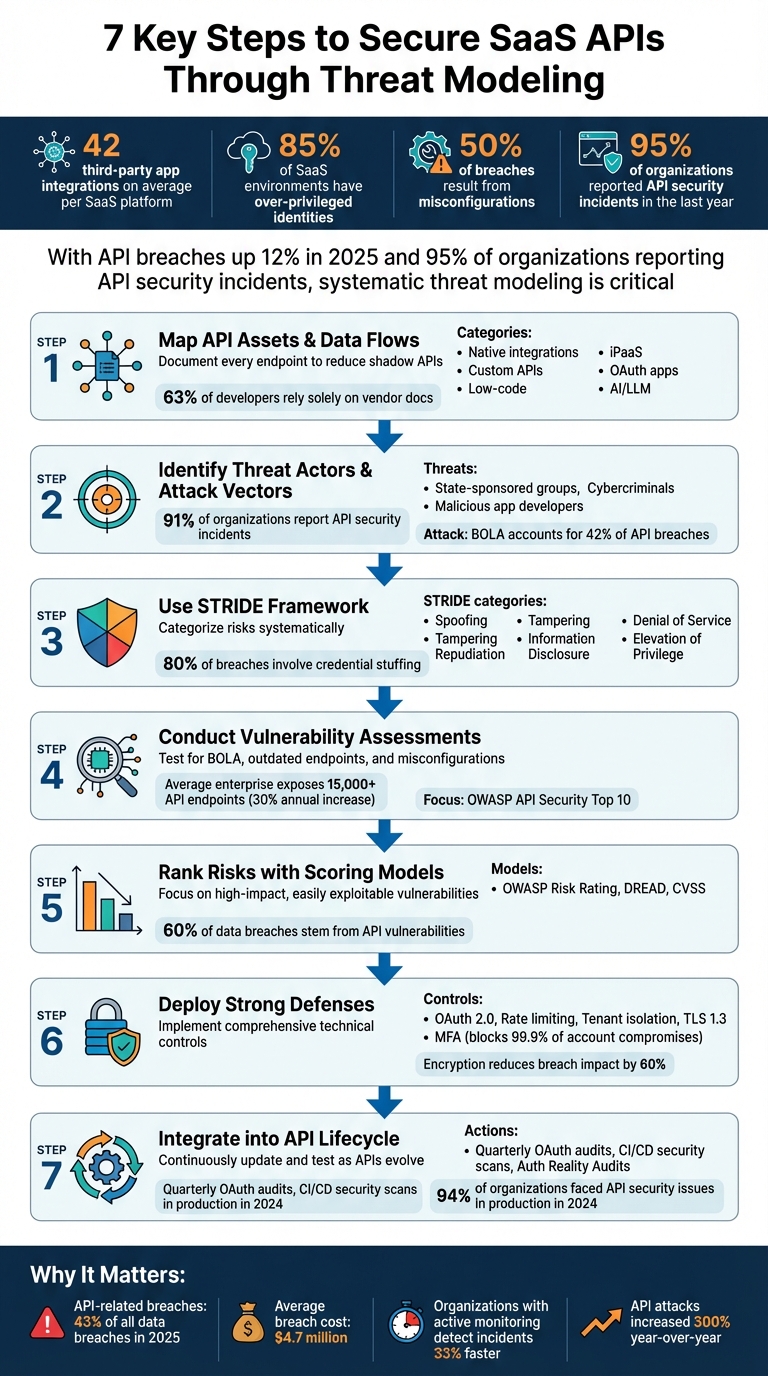
7 Steps to Secure SaaS APIs Through Threat Modeling
CISO Workshop on API Threat Modeling: How to Use STRIDE to Predict, Prevent, and Protect
sbb-itb-18d4e20
1. Map Your API Assets and Data Flows
A thorough inventory of your APIs is a must. Why? Because 95% of organizations reported API security incidents in the last year. Many of these breaches trace back to undocumented endpoints that bypass security reviews. The first step in building a strong threat model is identifying and cataloging every API your SaaS platform uses or exposes. This inventory becomes the foundation for analyzing threats and reducing risks.
Steps to Secure SaaS APIs
Start by using tools like API gateways, runtime tracing, and cataloging platforms to uncover all endpoints. Supplement this with data from Kubernetes Ingress definitions, load balancer setups, and cloud provider metadata to catch shadow APIs - those created outside official processes. Don’t just rely on vendor documentation; 63% of developers depend solely on vendor docs for integrations, which can leave gaps.
After identifying your APIs, organize them into categories such as:
- Native integrations
- iPaaS platforms
- Custom APIs
- OAuth-based apps
- Low-code automations
- AI/LLM integrations
Each category comes with its own risks. For example, a compromised iPaaS connection could jeopardize workflows across critical systems.
Once your endpoints are cataloged, shift focus to understanding the data flows and risk boundaries associated with each API.
Tackling SaaS-Specific API Risks
Map the full data lifecycle for each API, from entry points to internal data transfers and external exits. Pay special attention to sensitive data like PII and user credentials - 81% of breaches involve stolen credentials. Identify trust boundaries where access levels change, such as between a user session and backend services. This detailed mapping is the backbone of effective threat modeling, ensuring all exposure points are accounted for.
Unauthorized access is another major concern, with 83% of companies reporting incidents tied to it. To mitigate this, perform quarterly audits to revoke inactive OAuth permissions, especially for former employees. Assign each endpoint an owner and sensitivity label to ensure accountability during threat assessments.
How This Aligns with Industry Standards (e.g., STRIDE, OWASP)
A complete API inventory directly addresses OWASP API9: Improper Inventory Management by eliminating shadow and outdated APIs. It also helps uncover BOLA (Broken Object Level Authorization) vulnerabilities - the top threat in the OWASP API Security Top 10 - by tracing how object IDs move through your system and confirming that ownership checks are enforced at every stage.
Without accurate data flow diagrams, applying frameworks like STRIDE becomes nearly impossible. These diagrams let you evaluate threats like Spoofing or Information Disclosure at every transition point.
"BOLA (Broken Object Level Authorization) is the number one risk in the OWASP API Security Top 10 and is trivially exploitable but nearly invisible to most automated scanners." - Suphi Cankurt, AppSec Expert
2. Define Threat Actors and Attack Vectors
Once you've mapped your APIs, the next step is to identify vulnerabilities by understanding the threat actors targeting your endpoints. With 91% of organizations reporting API security incidents and attacks increasing by 300% year-over-year, recognizing who your adversaries are allows you to prioritize defenses where they’re needed most.
Relevance to SaaS-specific API Challenges
SaaS platforms operate in a unique threat environment. For example, state-sponsored groups often target executive communications by exploiting OAuth token vulnerabilities. In January 2024, Russia's Midnight Blizzard gained access to Microsoft senior leadership emails by abusing a legacy OAuth application with excessive permissions. They bypassed multi-factor authentication (MFA) using password spraying techniques. Similarly, cybercriminals focus on financial rewards through methods like credential stuffing and account takeovers. The 2024 Snowflake breach, which affected over 165 organizations without MFA protection, highlights this risk.
Another tactic involves malicious app developers creating fake integrations, such as the "Salesforce Mobile Connector", to trick users into granting persistent OAuth access. Broken Object Level Authorization (BOLA), where attackers manipulate user_id parameters to access other users' data, accounts for 42% of API breaches. OAuth token abuse is especially concerning because these tokens bypass MFA and single sign-on (SSO), granting attackers ongoing access even after password resets.
The average enterprise connects to 342 SaaS applications, each generating OAuth tokens and API keys that widen the attack surface. Shadow and zombie APIs - those undocumented or deprecated - comprise 40% of an organization’s API attack surface and often lack updated security measures.
Actionability for SaaS API Security
To strengthen API security, start by profiling threat actors based on your industry and the sensitivity of your data. For instance, financial services are more likely to encounter state-sponsored attacks, while e-commerce platforms often deal with credential stuffing and data scraping. Map these threat actors to their attack methods - such as initial access, persistence, privilege escalation, lateral movement, and data exfiltration - using the SaaS attack lifecycle.
"Identity becomes the only control layer, and attackers have learned to bypass it. OAuth tokens function independently of SSO and MFA." - Obsidian Security
Don’t overlook non-human identities like service accounts, API keys, and OAuth tokens. Monitoring these access points is essential for identifying unusual behavior. Behavioral monitoring can reveal anomalies like sequential ID enumeration or unexpected spikes in data exports. With attackers taking just 9 minutes on average to compromise core SaaS systems after gaining initial access, automated detection tools are vital.
3. Use the STRIDE Framework for API Threats
Once you've cataloged your assets and identified potential threat actors, the STRIDE framework offers a systematic way to pinpoint and address vulnerabilities in SaaS APIs.
Alignment with Industry Standards (e.g., STRIDE, OWASP)
Developed by Microsoft, STRIDE categorizes security risks into six areas: Spoofing, Tampering, Repudiation, Information Disclosure, Denial of Service, and Elevation of Privilege. This framework is so foundational that the OWASP Application Security Verification Standard (ASVS) 3.0.0 includes creating a STRIDE threat model as a key requirement for secure design. When combined with Data Flow Diagrams (DFDs) - which map external entities, processes, data stores, and API calls - STRIDE becomes even more effective.
The framework helps you ask critical questions about your design, identify risks, and evaluate mitigation strategies. A major focus is on trust boundaries, where data crosses from one privilege level to another, such as moving from the public internet to an internal SaaS network. These areas are prime targets for attackers. Fixing design flaws at this stage is far less expensive than addressing them later.
Relevance to SaaS-Specific API Challenges
SaaS APIs face unique challenges, and STRIDE tackles these head-on. For example, the Spoofing category highlights authentication risks, like credential stuffing, which contributes to 80% of data breaches. Elevation of Privilege uncovers issues such as Insecure Direct Object References (IDOR), where attackers manipulate parameters to access unauthorized data. Similarly, Information Disclosure focuses on APIs that return excessive data or error messages revealing internal system details. With 83% of organizations reporting security incidents tied to unauthorized API access - and 78% of breaches potentially detectable through better logging - STRIDE can help close critical security gaps.
"Threat modeling finds problems before the code exists - when they're cheapest to fix."
- AquilaX
Actionability for SaaS API Security
STRIDE doesn't just identify risks; it also guides actionable security improvements for your API architecture.
Start with a quick, focused whiteboard session - 60 to 90 minutes - to develop a threat model. Begin by sketching a simple DFD of your API architecture, then apply each STRIDE category systematically. For Spoofing, strengthen authentication with OAuth 2.0, JWT, and MFA. To combat Tampering, use TLS 1.3 for secure data transmission and digital signatures to ensure data integrity. Address Denial of Service by implementing rate limiting and throttling - especially crucial since 95% of applications remain vulnerable. For Elevation of Privilege, enforce strict input validation and adopt Role-Based Access Control (RBAC) across all layers.
Take advantage of tools like the Microsoft Threat Modeling Tool or OWASP Threat Dragon to create STRIDE threat models directly from your diagrams. Update these models annually, or whenever significant architectural changes occur, such as adding new third-party integrations or transitioning to a microservices setup. Finally, map identified threats to specific test cases, such as verifying JWT manipulation.
4. Run API Vulnerability Assessments
Relevance to SaaS-Specific API Challenges
SaaS platforms often expose a staggering number of API endpoints, making regular vulnerability assessments a necessity. On average, enterprises now expose over 15,000 API endpoints, with this number increasing by 30% annually. These platforms typically integrate with more than 42 third-party applications through OAuth tokens and API keys, which significantly heightens their risk exposure. The stakes are clear: API-related breaches made up 43% of all data breaches in 2025 - a 12% jump from the year prior - with the average breach costing $4.7 million.
The risks are compounded by shadow APIs - endpoints that aren't documented - and zombie APIs, which are outdated versions still accessible but lacking proper security measures. A few high-profile incidents underline the danger. In 2022, Optus, an Australian telecommunications company, exposed 9.8 million customer records due to an unauthenticated API endpoint. The following year, T-Mobile faced a similar issue, with an API flaw leaking 37 million records. These examples highlight why 95% of organizations reported an API security incident within 12 months. Clearly, continuous and proactive vulnerability assessments are critical for preventing these costly breaches.
Actionability for SaaS API Security
After mapping API assets, the next step is to extend the process with comprehensive vulnerability testing. Start with API discovery by examining API gateways, Kubernetes Ingress settings, and network traffic to identify all endpoints. Once the endpoints are inventoried, prioritize testing those that handle sensitive data like PII, payment information, or administrative functions.
A combination of automated and manual testing is key. Automated tools can scan for injection vulnerabilities, misconfigurations, and schema compliance issues. However, they often overlook business logic flaws, such as manipulating payment sequences, which require manual penetration testing. For instance, test for Broken Object Level Authorization (BOLA) by attempting to access another user’s resources using a valid token. If successful, you've identified a critical vulnerability.
"BOLA (Broken Object Level Authorization) is the number one risk in the OWASP API Security Top 10 and is trivially exploitable but nearly invisible to most automated scanners."
- Suphi Cankurt, AppSec Specialist, AppSec Santa
To catch issues early, integrate security testing into your CI/CD workflow. Use tools like 42Crunch to audit OpenAPI specifications against 300+ security checks during the design phase, reducing the chance of flaws reaching production. Test rate limiting by sending high-volume requests - such as 1,000 per second - and confirm your API responds with an HTTP 429 error. Similarly, check for pagination abuse by requesting extreme page sizes to prevent resource exhaustion. Finally, implement runtime monitoring to track production traffic for anomalies, such as unusual object enumeration or credential stuffing attempts.
Alignment with Industry Standards (e.g., STRIDE, OWASP)
Structure your vulnerability assessments around the OWASP API Security Top 10, a trusted framework for identifying API-specific risks. Pay special attention to API1 (BOLA), API2 (Broken Authentication, like testing token expiration), API3 (Mass Assignment, such as adding unexpected properties like isAdmin: true to JSON requests), and API4 (Unrestricted Resource Consumption, by verifying rate limits and pagination caps). For authentication, test for algorithm confusion by switching JWT signing algorithms from RS256 to HS256 or even "none" to see if the server still validates the token.
Regular testing isn’t just a good practice - it’s often a compliance requirement under standards like PCI DSS 4.0, SOC 2 Type II, and HIPAA. By aligning your assessments with these frameworks, you can strengthen your API security posture while meeting regulatory obligations.
5. Rank Threats with Risk Scoring Models
Once you've identified API vulnerabilities, the next step is to rank them based on their risk levels. This ensures you focus on the most critical issues that could have the biggest impact.
Relevance to SaaS-Specific API Challenges
API vulnerabilities are no small matter - over 60% of data breaches stem from them, and 40% of organizations report that more than half of their APIs have security issues. For SaaS companies, this challenge is amplified. Limited security resources often need to cover thousands of endpoints, making prioritization essential. Without a structured ranking system, you risk wasting time on minor issues while leaving major threats unchecked.
The financial consequences are just as concerning. Companies that prioritize compliance spend about $3.86 million on average for data breaches, compared to $4.24 million for those that don't. For SaaS platforms managing multi-tenant data, a single poorly prioritized threat could expose thousands of customers at once. This is why risk scoring models that evaluate both exploitability and impact are so important - they help you focus on the threats that matter most and guide your mitigation efforts effectively.
Actionability for SaaS API Security
To rank threats effectively, consider using the OWASP Risk Rating Methodology, which calculates risk by multiplying Likelihood (e.g., threat agent and vulnerability) by Impact (technical and business). Pay close attention to threats like BOLA (Broken Object Level Authorization) and Unrestricted Resource Consumption, which are known for causing significant financial and data losses.
Another useful tool is the DREAD model, which scores threats across five categories: Damage potential, Reproducibility, Exploitability, Affected users, and Discoverability. Each category is rated from 1 to 10, and threats with high scores in Damage and Exploitability should be addressed first.
For standardized scoring, use the Common Vulnerability Scoring System (CVSS). This system assigns a score from 0 to 10 based on Base metrics (exploitability and impact), Temporal metrics (remediation status), and Environmental metrics (specific to your infrastructure). CVSS is especially useful for comparing vulnerabilities in third-party dependencies. Companies that conduct annual security assessments uncover 30% more vulnerabilities than those that skip them, highlighting the value of regular reviews.
Alignment with Industry Standards (e.g., STRIDE, OWASP)
To ensure your efforts align with industry best practices, map your ranked threats to the OWASP API Security Top 10. This helps you address widely recognized risks. You can also use STRIDE to categorize threats before scoring. STRIDE organizes threats into six categories: Spoofing, Tampering, Repudiation, Information Disclosure, Denial of Service, and Elevation of Privilege. Once categorized, apply DREAD or CVSS scores to each group.
Looking ahead, SaaS companies incorporating AI features by 2026 must prepare for emerging threats like prompt injection, model theft, and training data extraction. For example, rate limiting has proven effective in mitigating Denial of Service attacks, reducing service interruptions by 70% when properly implemented.
Additionally, leverage tools like Pynt within your CI/CD pipeline to stay on top of evolving risks. Pynt ranks vulnerabilities based on real-world exploitation frequency, giving you a clear picture of what attackers are actively targeting. In 2023, injection vulnerabilities were the second most critical issue across over 100,000 tested API endpoints, even though they were not included in the OWASP API Top 10. Combining multiple frameworks and tools ensures you get the most accurate and comprehensive view of your risk landscape.
6. Deploy Mitigation Strategies and Technical Controls
Relevance to SaaS-Specific API Challenges
Once you've ranked risks, the next step is implementing defenses tailored to SaaS environments, particularly multi-tenancy. This setup introduces unique challenges that general security measures can't fully address. For instance, authorization flaws are a leading cause of SaaS data leaks, and stolen credentials contribute to 80% of breaches.
In a multi-tenant system, every API request must confirm not just the user's identity but also their permission to access specific resources. This is critical to combat issues like Broken Object Level Authorization (BOLA), which is the primary driver of API data leaks. Multi-Factor Authentication (MFA) can prevent up to 99.9% of account compromise attacks, while encryption can reduce the impact of breaches by 60%.
Actionability for SaaS API Security
To strengthen your SaaS API security, implement OAuth 2.0 or OIDC with enforced MFA, short-lived tokens (15–60 minutes), and regular token rotation.
"Authentication is your first line of defense. Get it wrong and nothing else matters".
- Open Door Digital
Beyond authentication, focus on securing data flows and ensuring tenant isolation. Here are some key measures:
- Tenant Isolation: Include a tenant identifier (e.g.,
org_idortenant_id) in every API call and database query. Use Row Level Security (RLS) in databases like Postgres to ensure users access only their tenant's data. - Centralized Authorization: Implement middleware for authorization checks to avoid scattered, inconsistent logic that attackers could exploit.
- Rate Limiting: Apply rate limits at both the IP and account/tenant levels. This reduces the risk of Denial of Service (DoS) attacks and "noisy neighbor" issues, which are especially relevant since 95% of applications are vulnerable to DoS attacks.
- Schema Validation: Use tools like Joi or Zod to block unauthorized fields and prevent mass assignment attacks, such as injecting
isAdmin: true. - Secure Webhooks: Protect webhooks with HMAC or Ed25519 signatures to ensure data authenticity.
- API Key Management: Store keys in managed secret stores and rotate them every 90 days or when employees leave.
- TLS and Security Headers: Enforce TLS 1.3 for all data in transit and use strict headers like
X-Content-Type-Options: nosniffandStrict-Transport-Security(HSTS).
Alignment with Industry Standards (e.g., STRIDE, OWASP)
To align with industry standards, map your security controls to the OWASP API Security Top 10 and address threats identified in STRIDE. Here's how specific mitigations apply:
| STRIDE Threat | Mitigation Control | SaaS Relevance |
|---|---|---|
| Spoofing | OAuth 2.0, OIDC, MFA, PKCE | Securing user and service identities |
| Tampering | HMAC signatures, TLS 1.3 | Protecting data integrity in multi-tenant flows |
| Repudiation | Structured audit logging | Tracking actions across tenant accounts |
| Information Disclosure | Encryption, RBAC, Data masking | Preventing cross-tenant data leakage |
| Denial of Service | Rate limiting, Quotas | Preventing resource exhaustion |
| Elevation of Privilege | Least privilege IAM, BOLA checks | Ensuring tenants cannot access admin functions |
Incorporate automated vulnerability detection tools like SAST and DAST into your CI/CD pipelines to catch OWASP-related risks early. Addressing security issues during the design phase is 30 times cheaper than fixing them post-deployment.
"Threat modeling finds problems before the code exists - when they're cheapest to fix. Changing a data model or authentication flow at design time is a discussion. Changing it after deployment is a migration, a security patch, and potentially a compliance event".
- DevSecOps team at AquilaX
As SaaS APIs integrate AI features, additional measures are necessary. Treat LLM prompts as untrusted input and use regex or allowlists to block prompt injection via APIs. Apply stricter rate limits to sensitive endpoints like /login or AI inference routes compared to standard GET requests. Use API discovery tools to identify undocumented "shadow" endpoints, which could bypass security measures.
7. Build Threat Modeling into the API Lifecycle
Relevance to SaaS-Specific API Challenges
Threat modeling isn’t just a task to check off once - especially in the fast-paced world of SaaS. APIs in these environments evolve quickly, which can expand the attack surface. A staggering 94% of organizations faced API security issues in production in 2024. This rapid pace often leads to rushed decisions around authentication and authorization, leaving gaps in security.
The distributed nature of SaaS architectures adds another layer of complexity. Features like webhooks, partner integrations, and machine-to-machine tokens can create vulnerabilities. While public APIs might get thorough scrutiny, internal service-to-service calls are often neglected. This can open the door to lateral movement during a breach. Alarmingly, 70% of organizations skip security testing for external integrations, and 50% experienced breaches tied to third-party APIs in 2024. This highlights the need to embed threat modeling into every stage of the API lifecycle.
Actionability for SaaS API Security
Start integrating threat modeling at the design phase - not after deployment. Identifying risks early helps prevent future headaches. Using OpenAPI (Swagger) specifications as a security contract can define input/output schemas and authentication rules before any code is written. This proactive approach, often called "shift-left", can save time, money, and effort when addressing security concerns.
To strengthen security further, automate scans in your CI/CD pipeline. Add tools for vulnerability scanning (SAST and DAST) and block APIs with low security scores from reaching production. Include negative-path tests to ensure tenant boundaries and privilege controls are solid. Regularly audit API logs - ideally every quarter - to identify and clean up shadow or zombie APIs.
Another practical step is conducting quarterly "Auth Reality Audits". Dedicate 90 minutes to reviewing your 10 highest-risk endpoints - such as admin functions, billing, or data exports. Confirm that server-side authentication and authorization controls are working as intended. This is especially critical given that 31% of customer-facing APIs still lack basic HTTPS encryption, leaving them vulnerable during rapid development cycles.
Alignment with Industry Standards (e.g., STRIDE, OWASP)
To ensure a thorough approach, align your threat modeling efforts with established frameworks. The STRIDE framework is a great tool during the design phase, helping teams identify potential threats like Spoofing, Tampering, Repudiation, Information Disclosure, Denial of Service, and Elevation of Privilege. During development, follow the OWASP API Security Top 10 to address common vulnerabilities such as Broken Object Level Authorization (BOLA) and Mass Assignment.
"Threat Modeling is an ongoing journey in the API life cycle and doesn't end after creating a threat model."
- Aastikta Sharma
Organizations that use API management tools report 50% fewer security incidents due to improved oversight. Centralizing identity primitives and adopting policy-as-code can reduce inconsistencies in permissions across services. The key is to continuously update threat models, ensuring your SaaS API security remains strong across all integration points.
Conclusion
SaaS breaches have skyrocketed by 300% in 2024, revealing critical weaknesses that call for constant updates to threat modeling strategies. As the threat landscape shifts, your approach to securing SaaS platforms must adapt in tandem.
The steps outlined here - asset mapping, defining threat actors, applying STRIDE, conducting vulnerability assessments, scoring risks, deploying controls, and integrating these measures into the lifecycle - serve as a practical guide. However, the real hurdle is putting them into action. Patrick Opet, CIO of JPMorgan Chase, highlights the risks posed by the intricate integration networks of the modern SaaS ecosystem. With integrations growing by 123% year-over-year, the attack surface is expanding at an alarming rate.
Start with achievable steps right now. For instance, a 30-day hardening sprint can help identify all user and service identities while enforcing strict authorization at API endpoints. Quarterly OAuth audits can ensure outdated integrations are revoked, and implementing least privilege principles across API calls reduces unnecessary exposure. These small but impactful changes can embed proactive threat modeling into your routine.
The benefits are clear. Organizations with active monitoring detect security incidents 33% faster than those without. Combining least privilege with multi-factor authentication can block up to 99.9% of account compromise attacks. Beyond improved security, proactive threat modeling enhances customer confidence and ensures compliance with regulations like GDPR, HIPAA, and PCI DSS, helping you avoid hefty fines and reputational risks.
APIs are the backbone of your SaaS platform. Securing them isn’t just about technology - it’s a core business priority. Making threat modeling an ongoing effort not only addresses today’s vulnerabilities but also strengthens your defenses for the challenges ahead.
FAQs
What’s the fastest way to find shadow and zombie APIs?
To quickly spot shadow and zombie APIs, use runtime-aware inventory systems paired with static (SAST) and dynamic (DAST) application security testing tools. These solutions work together to continuously identify, verify, and handle undocumented, outdated, or deprecated APIs in active environments. This approach ensures improved oversight and strengthens security measures.
How can I prove tenant isolation on every API request?
To maintain tenant isolation for every API request, it's crucial to set up tenant context as early as possible in the request lifecycle. This can be done effectively using middleware or interceptors. Always rely on secure, hard-to-guess tenant-specific identifiers to ensure safety. Implement access controls tailored to tenants, such as Role-Based Access Control (RBAC) or Attribute-Based Access Control (ABAC), to manage permissions appropriately.
Additionally, make it a habit to regularly verify tenant identity and permissions to avoid any lapses. Keep an eye on tenant-specific activity through monitoring systems to detect and prevent issues like cross-tenant data exposure or unauthorized access. These steps are essential for safeguarding tenant data and ensuring proper isolation.
Which risks should I fix first if my API inventory is huge?
If your API inventory is extensive, it's crucial to tackle risks associated with poor asset management first. This includes addressing outdated or neglected APIs that could become easy targets for attackers. Pay close attention to major vulnerabilities outlined by OWASP, such as broken object-level authorization and authentication issues. These are serious security risks that demand immediate attention to safeguard your APIs.
-4.png)
-Sep-23-2026-09-52-49-6890-AM.png)